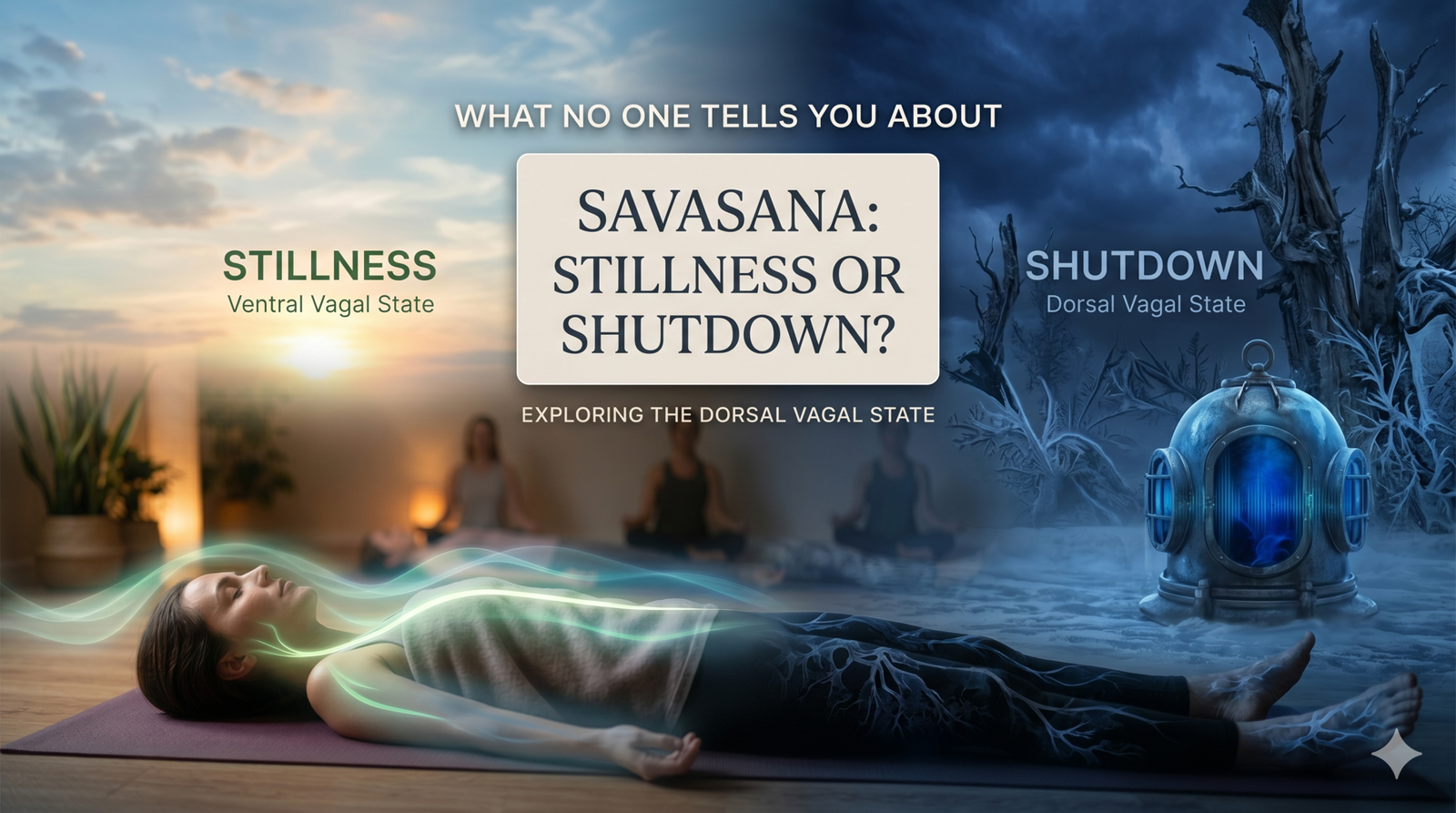
For many individuals who practice yoga, Savasana is seen as the most effortless aspect of class; it is simply some peaceful moments lying on the mat so the body and mind can integrate the benefits of the class. Many yoga instructors say that this pose is relaxing, restorative, and peaceful. However, for some students, understanding the connection between the dorsal vagal state and Savasana can reveal why the experience is anything but.
Rather than feeling relaxed, some individuals can feel restless, anxious, uncomfortable emotionally, numbed, or even in a desperate need to run away from the situation. This type of reaction can seem quite baffling since everyone around seems to be having a pleasant time.
One crucial thing not mentioned here is the nervous system. Understanding the connection between stillness, trauma, and dorsal vagal state can revolutionise our understanding of the practice of Savasana in classes.
In this article, we will look at Savasana and the Dorsal Vagal State, reasons why stillness can be threatening for some people, and trauma-informed yoga cueing for a more supportive experience of Savasana in classes.
What Is Savasana?
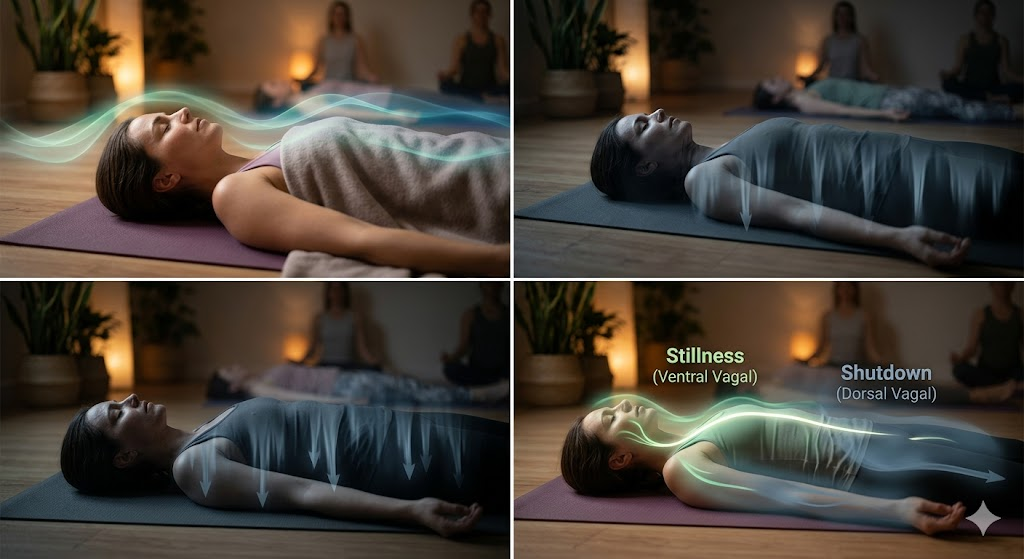
Savasana, also known as “Corpse Pose,” is usually done towards the end of a yoga practice. In this pose, the individual lies down flat on their back, requiring little to no physical effort and resting their entire body.
Physiologically speaking, practising Savasana involves moving from a state of sympathetic arousal, commonly referred to as the “fight or flight response,” to a parasympathetic state of being regulated.
But relaxing doesn’t always come easy.
For those who have experienced prolonged stress, trauma, anxiety, and nervous system dysregulation, sitting quietly could trigger their fight or flight response.
That is when knowing about Savasana and the Dorsal Vagal State becomes crucial.
Understanding the Nervous System Through Polyvagal Theory
To appreciate why savasana is sometimes difficult, it is important to look at the Polyvagal Theory, formulated by Dr Stephen Porges.
The polyvagal theory suggests that the autonomic nervous system acts through three main types of states:
1. Ventral Vagal State – Safety and Connectedness
This is the state that all yoga instructors wish their students would achieve during savasana.
It is characterised by:
- Being relaxed and grounded
- Openness to emotions
- Social connectedness
- Curiosity
- Resting without any fear
Also called the “rest and digest” state.
2. Sympathetic State: Fight or Flight
Energy is released by the nervous system in response to feeling threatened.
Signs could include:
- Panic
- Accelerated heartbeat
- Tension in the muscles
- Heightened awareness
- Fidgeting
Such students will have difficulty sitting still while performing Savasana.
3. The Dorsal Vagal State: Shutdown and Immobility
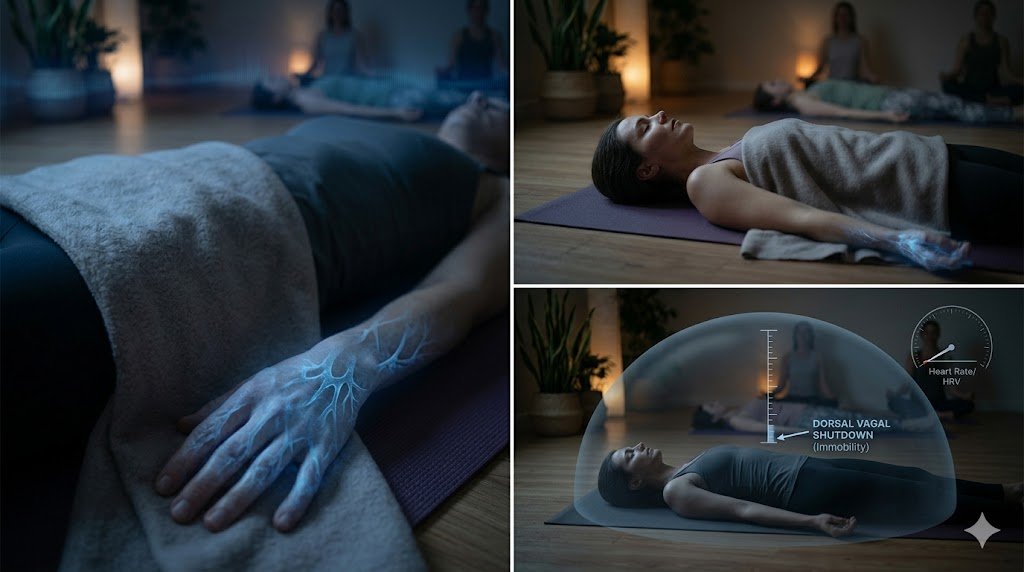
Dorsal vagal response occurs when the nervous system detects an unmanageable threat and feels escape is not possible.
Signs could include:
- Detachment
- Numbness
- A sense of separation from the body
- Fatigue
- Collapse
- Lack of energy
While the state seems relaxed outwardly, this is not how the individual feels internally.
It is important to make this distinction in the context of Savasana.
Why Stillness Can Feel Threatening Instead of Relaxing
However, many students of yoga believe that pain during the Savasana posture is a sign that something is done incorrectly.
In fact, it might just be that the body reacts to the stillness with its memories and previous experience.
The Body Remembers
- With no more movement, distractions are gone.
- One can become suddenly aware of:
- Emotional tensions that have been stored within
- Stress that hasn’t been released
- Physical sensations that have not been noticed before
- Vulnerability memories
For a person with PTSD, being motionless and closing your eyes might recall a situation when you felt helpless and defenceless. Thus, for the nervous system, the Savasana posture might be perceived as a danger rather than relaxation.
Lack of Movement Removes Protective Strategies
Most individuals unconsciously deal with stress by moving.
Such movements include:
- Walking
- Fidgeting
- Exercising
- Speaking
- Working
Without Savasana to provide these mechanisms of coping, difficult feelings can emerge.
Silence Can Amplify Internal Experiences
Silence often intensifies awareness of internal states.
Trauma-sensitive yoga might cause one to feel:
- Anxiety
- Sadness
- Fear
- Isolation
- Dissociation
They do not signify failure on your part. They signify that the nervous system is communicating crucial information.
Savasana and the Dorsal Vagal State: When Rest Feels Like Shutdown
Perhaps the most commonly misunderstood part about yoga is that silence always means healing.
It is possible that relaxation is really dorsal vagal engagement.
How to Recognise Dorsal Vagal Activation
When a student experiences a dorsal vagal shutdown, she/he might say:
- Being stuck
- Mental clouding
- Feeling very heavy
- Lack of emotions
- Feeling like disappearing
Since the body is still in Savasana, it is quite easy to mistake these for profound relaxation.
However, real restoration requires an emotional state of safety and being present.
Shut down often means disconnecting. Knowing the difference can help instructors avoid inadvertently triggering the nervous system into a shutdown.
The topic of Savasana and the Dorsal Vagal State calls for going beneath the surface.
Why Traditional Savasana Instructions May Not Work for Everyone
Most yoga instructors have received their training through cues such as:
- “Let go entirely.”
- “Surrender.”
- “Stay still.”
- “Closure of the eyes.”
- “Deep relaxation.”
Though effective for some students, these cues might be too much for other individuals.
For example, a person with a history of trauma would not react positively to such cues, since they tend to take away control from the individual.
The nervous system usually feels more secure with choices at hand.
Trauma-informed yoga, therefore, encourages self-autonomy over obedience.
This means that rather than giving commands, instructors can choose to invite students.
Trauma-Informed Approaches to Savasana and the Dorsal Vagal State
A better Savasana practice doesn’t mean a lack of stillness.
It means setting up circumstances which help with nervous system regulation.
Provide Options
Offer Choices
Choice is one of the most effective methods of trauma-sensitive teaching.
Some examples are:
- Eyes open or closed
- Reclined or sitting position
- Use of props for support
- Stillness or small movements
If people have choices, their nervous systems feel safe.
Normalise Different Experiences
Teachers could remind students about diverse relaxation experiences.
Words like:
“There’s no wrong way to relax in this moment.”
Such words relieve pressure and performance anxiety.
Encourage Interoceptive Awareness
Instead of forcing stillness, offer an interoceptive exploration opportunity.
Some examples are:
- Experience how your body is supported by the surface.
- Note your breathing process without altering it.
- Feel your body contacting the ground.
Keep Students Connected to the Present
Grounding strategies may prove useful to prevent dissociative episodes.
Examples of grounding exercises are:
- Focusing on sounds around you
- Being aware of how your clothes feel
- Monitoring your breathing
- Looking around your surroundings
Grounding is useful for nervous system regulation.
Signs a Student May Need Alternatives to Traditional Savasana
Back lying for all individuals may not be comfortable for all students.
Other relaxing postures may be utilised for more comfort and safety.
Signs may include:
- Anxiety throughout Savasana
- Overwhelming emotions
- Panic attacks
- Dissociative feelings
- Traumatic experiences
- Painful physical conditions
- Some other choices might be:
Constructive Rest Pose
- Resting with legs bent and feet grounded is another way of achieving stability.
- Side-Lying Relaxation Posture
- Resting on the side gives individuals a feeling of protection and support.
- Seated Meditation Position
- In some instances, standing is a more comforting choice.
- Restorative Yoga Poses with Support
- Props such as blankets and bolsters may add more sensory comfort.
The Difference Between Relaxation and Freeze
First, there are many similarities between relaxation and freeze states.
Knowing this difference could be useful for teaching and individual practice alike.
The goal of yoga isn’t necessarily stillness.
| Relaxation | Dorsal Vagal Shutdown |
| Feels safe | Feels disconnected |
| Present and aware | Numb or detached |
| Calm breathing | Shallow or restricted breathing |
| Sense of ease | Sense of collapse |
| Connected to surroundings | Withdrawn from surroundings |
The goal is to develop awareness, presence, and regulation.
How Yoga Teachers Can Create Safer Savasana Experiences
Yoga instructors have a major influence on the way their students relax.
Some useful methods include:
Use Invitational Language
Instead of saying:
“Close your eyes.”
Say:
“If you’re comfortable with it, you can gently close your eyes.”
Avoid Forcing Stillness
Students shouldn’t be restricted in their ability to:
Change positions
Stretch
Alter the way props are used
Sitting up when necessary
Explain the Purpose
Educating students about their nervous system response makes them less likely to feel ashamed.
When they learn that feeling uncomfortable is natural, they’re more open-minded about the practice.
Build Regulation Before Stillness
Movements, breath control, and grounding practices can ease students into the relaxed state. These techniques facilitate somatic healing and make the practice more accessible.
A New Perspective on Savasana
In yoga culture, Savasana has long been viewed as an inherently soothing posture.
- This isn’t always the case.
- Where some people find room for restoration in stillness,
- Others find themselves experiencing the symptoms of trauma, stress,
- or their body’s natural response to protect itself.
- None of these experiences is necessarily wrong.
- Recognising what Savasana and the Dorsal Vagal State entail,
- We can learn to stop judging and start understanding.
- Rather than focusing on, “How can I force myself to relax?”
- The question can become, “What is my nervous system trying to tell me?”
- Such a question, itself, can lead to profound transformation.
- By teaching Savasana from a trauma-informed perspective,
- a whole new world of healing is possible.
Conclusion
The Savasana pose can be considered one of the easiest positions in Yoga, but at the same time, it is one of the poses where the body’s nervous system can experience the most complex processes. As people can achieve the state of deep relaxation during the practice of Savasana, there are those who feel uncomfortable, anxious, dissociated or shut down by it.
The knowledge about Savasana and the Dorsal Vagal State can help in realising that stillness does not mean being safe for every individual.
With the implementation of trauma-informed yoga, polyvagal theory, nervous system regulation, somatic healing, and mind-body awareness techniques into our practice, we can support people instead of putting them under pressure.
Thus, the main idea of the Savasana pose is meeting oneself with awareness and compassion.
FAQs
1. Why Do You Feel Anxious Instead of Relaxing During Savasana?
This is caused by the fact that stillness might activate the natural defence mechanisms of your nervous system. Some people can become aware of their stress, unresolved emotional experiences, or vulnerabilities while lying still. It is important to note that it doesn’t mean you practice Savasana wrong.
2. What Is the Dorsal Vagal State in Yoga?
Dorsal vagal state occurs due to your body’s reaction to a stressful situation, and the brain perceives immobilisation/shutdown/disconnection as the appropriate response. It is possible to confuse this phenomenon with relaxation, as they share the element of stillness.
3. How Can Trauma-Informed Yoga Improve Your Experience of Savasana?
Trauma-informed yoga pays attention to autonomy and choice and focuses on providing a space for safe regulation and connection with one’s own body. Thus, teachers will often provide options for eye focus, physical positions, movements, etc.