Your nervous system is the most important prop in the room. Developing co-regulation skills for yoga teachers can make a profound difference in the class experience for everyone.
Introduction
During training sessions for becoming a yoga instructor, many instructors spend hundreds of hours studying anatomy, body alignment, class sequencing, breath control, philosophical theories, and cueing techniques. Instructors study ways of guiding their bodies in different postures, creating effective classes, and overcoming physical obstacles for students. However, perhaps the most valuable resource that each yoga instructor has yet pays little attention to during training is their nervous system.
With every lesson that a yoga instructor gives, they provide much more than knowledge and skill. With every session, they enter the classroom with emotions, energy, focus, and the ability to establish connections. Without knowing it explicitly, each student picks up on the signals sent by the instructor subconsciously and reacts accordingly to those signals by activating their nervous system.
This occurs as a result of neurology and is related to co-regulation, defined as the relationship between two nervous systems that have a mutual influence on each other. Co-regulation skills for yoga teachers are the basis on which healing takes place in trauma-informed yoga, coaching, therapy, and education practices.
The concept of “holding space” is common among yoga instructors when they mention how they make sure that students are supported and feel secure, seen, and embraced. Despite its commonality in practice, most yoga instructors do not have an understanding of the science of holding space. Holding space is more than an emotion or spirituality-related experience, but a physiological one that involves the nervous system, social connection, and need for safety.
Understanding holding space from a neurological perspective can change how yoga teachers teach and connect with their students. Yoga teachers need to understand that the co-regulation skills for yoga teachers are not a privilege but a vital skill for effective teaching.
What Does It Mean to Hold Space?
Space-holding is described as the act of being present with another person without attempting to change, correct, judge, or hurry their experience.
When holding space in a yoga class, this may mean:
- Staying calm when your student starts getting emotional
- Being there for support while not imposing solutions
- Creating a psychologically safe environment
- Honoring everyone’s boundaries
- Letting your students progress at their own speed
- Being consistently present
While all these actions seem straightforward, they require that the instructor regulate themselves during times of uncertainty and emotional intensity.
Your students can pick up on whether or not they’re safe from you. If you feel insecure and overwhelmed, your students will likely sense it.
Here is where co-regulation comes in.
Understanding Co-Regulation
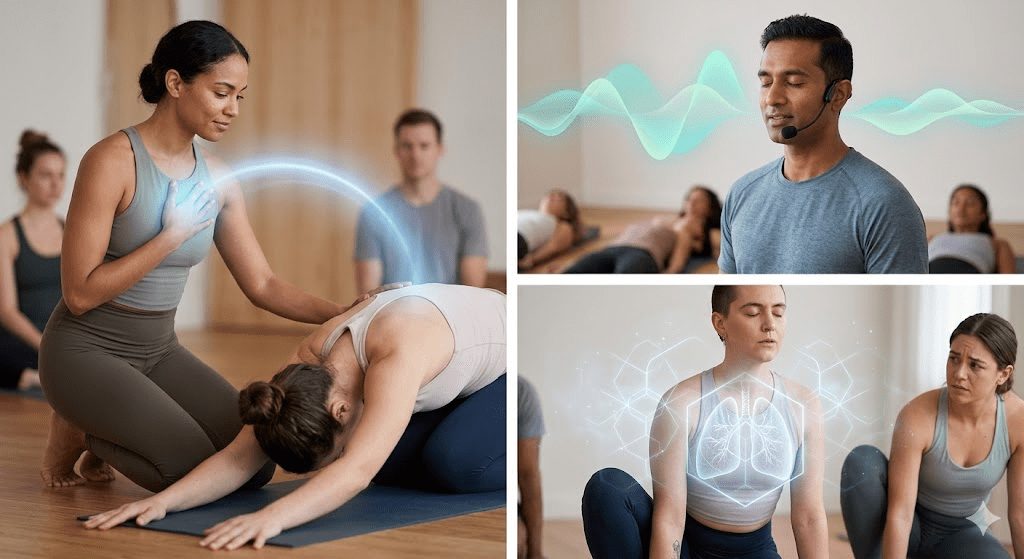
Co-regulation is the practice of one’s nervous system assisting another’s nervous system in finding balance. Human beings are biologically hardwired to connect. Right from birth, we begin learning how to regulate ourselves via relationships.
A baby will be unable to settle by itself. The baby needs the comforting presence of another person in terms of their voice, touch, facial expressions, and overall demeanor. Even if grown-ups are more regulated, there will always be some aspect of co-regulation that comes into play.
We continue looking for safety signals from:
- Friends
- Partner
- Family
- Therapists
- Teachers
- Coaches
- Community leaders
The yoga teacher, at times, takes on the role of temporary co-regulator in the class environment.
The Science Behind Co-Regulation
Neuroscience gives us great clues about why co-regulation is effective.
Autonomic Nervous System
The autonomic nervous system governs various bodily processes that include:
- Heart rate
- Respiration
- Digestive processes
- Stress responses
- Emotion regulation
This system is always assessing whether the environment is safe or dangerous.
If the environment seems to be safe, then the body can allow itself to be relaxed, connected, learn, and heal.
However, when the body perceives any threat, it goes into survival modes: fight, flight, freeze, and shutdown. What is significant about these processes is their nature. Students might not be aware of why they feel safe with some teachers but not others. Their nervous systems are constantly monitoring environmental conditions.
Polyvagal Theory and the Social Engagement System
The idea of co-regulation is well grounded in Polyvagal Theory, formulated by neuroscientist Dr. Stephen Porges.
The theory suggests that there exists a social engagement system in humans that allows us to evaluate our state of safety through interpersonal communication.
The nervous system focuses on:
- Facial expressions
- Tone of voice
- Eye contact
- Body language
- Movement rhythm
- Emotional resonance
Upon receiving messages of safety, the nervous system is prepared to receive, be flexible, and regulate itself. In other words, it means that besides the information received from yoga instructors during the class, students are also reacting to the manner in which they deliver their message.
Calmness of tone sometimes matters even more than clear instructions. Unlike conscious perception, neuroception occurs automatically. The nervous system asks:
- Am I safe?
- Am I threatened?
- Do I need to protect myself?
Based on these assessments, individuals move through different physiological states.
Ventral Vagal State: Connection and Safety
In a safe environment, an individual moves into a state marked by:
- Sociability
- Open emotionality
- Curiosity
- Ability to learn
- Deep breaths
- Cognitive acuity
This is the desired state for practicing yoga.
Sympathetic State: Fight or Flight
In response to a threat, the nervous system activates.
These could be signs of:
- Fear
- Nervousness
- Faster heartbeat
- Tension
- Excessive vigilance
Many participants come into class in this state.
Dorsal Vagal State: Shutdown
In a state of severe stress, the nervous system goes into shut-down mode.
The symptoms may be:
- Emotional numbness
- Fatigue
- Detachment
- Withdrawal
- No motivation
Being aware of the different states will help teachers understand that participant behavior may actually be related to nervous system activation rather than any lack of effort on their part.
Why Students Mirror Your Nervous System
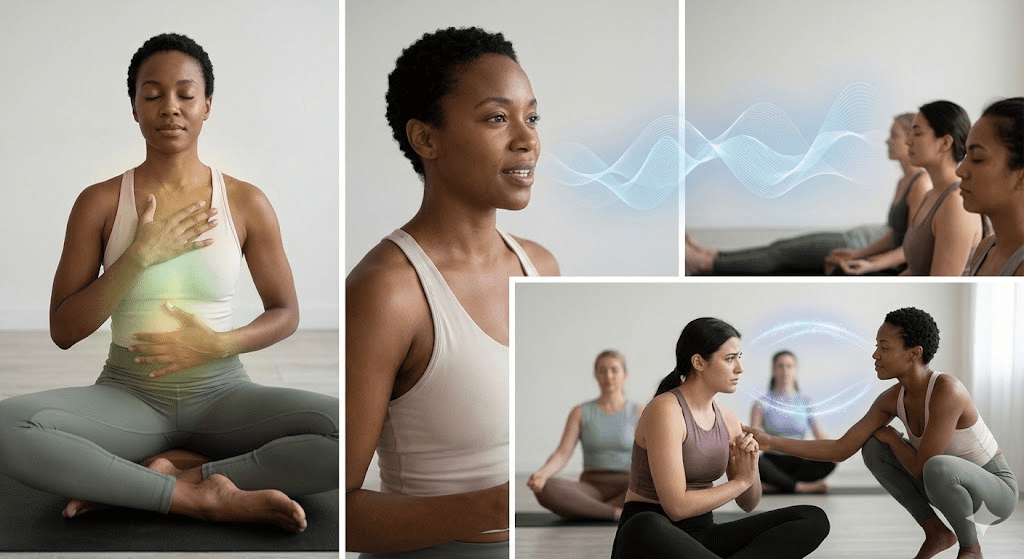
Humans have neural systems that facilitate emotional attunement and social bonding. Via facial expressions, vocal tonality, body language, and energy signals, humans subconsciously influence each other’s nervous systems.
This is how we can explain the following facts:
- Calming people tend to calm others
- Anxiety spreads among groups
- Confidence is sometimes contagious
- Stress pervades whole settings
When taking yoga classes, students receive input from their teacher’s nervous system nonstop. Suppose two teachers teach the same sequence of poses.
- Teacher A is quick-witted, looks uneasy, hurries transitions, and looks unfocused.
- Teacher B is precise in her movements, regulates breathing, makes eye contact, and speaks softly.
- Although they both say the same things, students will probably have different experiences since the nervous system reacts to much more than just verbal input.
- The teacher’s state of mind is incorporated into the learning process.
The Hidden Impact of Teacher Dysregulation
Yoga instructors are people, too. They feel stressed, sad, frustrated, and tired just like anyone else. Issues arise when instructors begin to ignore their own dysregulation.
Some symptoms include:
- Being rushed in class
- Oversharing information
- Struggling to be present
- Irritability
- Emotional reactivity
- Perfectionism
- Struggling to meet students’ needs
When instructors work from a place of chronic stress, students subconsciously pick up on a lack of safety.
This doesn’t mean instructors need to be completely calm all the time. Authenticity takes priority over perfection.
What we want is not emotional suppression but rather nervous system regulation.
An instructor who acknowledges stress and actively works to regulate will provide more security than one trying to stay calm in an otherwise stressed state.
Five Essential Co-Regulation Skills for Yoga Teachers
1. Develop Self-Regulation Before Teaching Others
Self-regulation lies at the heart of co-regulation.
Before entering class, teachers must check in with themselves.
Key questions to ask might include:
- How am I today?
- What emotional baggage do I bring?
- Is my breath shallow or deep?
- Am I in touch with my body?
Here are some ways to restore balance:
- Conscious breathing
- Meditation
- Movement
- Grounding techniques
- Silence
Students will gain the most from teachers who are present with themselves.
2. Use Your Voice as a Regulatory Tool
Our voice has a powerful effect on our nervous system reactions.
A slow and steady pace of speech can convey safety even better than any set words might.
Some good tips are:
- Slight slowing of the pace
- Intentional pauses
- Silence
- Positive tone of voice
- Absence of urgency
Our nervous system reacts to verbal input far quicker than we analyze the content of instructions.
3. Model Regulated Breathing
Breathing is one of the easiest ways to regulate the nervous system.
Students will automatically fall into step with the breath of the teacher.
By breathing deeply and rhythmically, teachers can set a physiological example for students.
This is particularly useful during:
- Difficult poses
- Release of emotions
- Restorative techniques
- Meditative practices
The teacher’s breath usually dictates the energy of the space.
4. Cultivate Attunement
Attunement means being able to recognize and respond to student needs appropriately.
Instead of sticking to a preset structure, an attuned teacher will be tuned in to what is actually going on.
Signs of attunement may include:
- Recognizing body language
- Picking up on shifts in energy
- Respecting individual boundaries
- Making adjustments
Attunement says, “I notice you, and I value your experience.” This sends a message that the nervous system recognizes and understands as safe.
5. Create Choice and Agency
Safety happens when students feel empowered.
Trauma-informed yoga instruction encourages providing choices versus commands.
Some examples are:
- “You could stay here or investigate the next variation.”
- “You have permission to relax whenever you wish.”
- “Observe what supports you physically in the moment.”
Giving choices allows students to stay present with their inner experience and not feel controlled.
Holding Space During Emotional Experiences
Sometimes Yoga reveals emotions stored in the body.
- Students might feel:
- Tears
- Anxiety
- Grief
- Relief
- Unforeseen memories
Often, teachers are encouraged to do something in such situations.
In fact, effective holding space doesn’t imply solving emotions.
But teachers could:
- Be grounded
- Keep distance
- Provide support
- Stay grounded
- Normalize emotions
The ability to be regulated by the experience of someone else’s emotions is the ultimate co-regulation skill.
The Future of Yoga: From Instruction to Co-regulation skills for yoga teachers
The yoga industry is changing. Yoga practitioners are no longer just interested in physical health. They are looking for stress relief, resilience, emotional balance, and real connection.
With the development of neuroscience, one realizes that change does not come only from the asanas or breathwork practice. Change happens through connection and interaction between nervous systems.
A teacher trained in co-regulation offers yet another dimension to their teaching.
They become guides toward safety, connection, and embodiment.
In many instances, the students may forget some asanas practiced in the class. They may forget some philosophies discussed in the class. But they won’t ever forget how they feel in the teacher’s presence.
Conclusion
While holding space may be just another term in the current wellness trend lexicon, this concept is deeply connected to the neurobiology of how human nervous systems connect and affect each other. Through co-regulation, yoga teachers can provide their students with an environment where they can feel safe and explore, grow, and heal.
Great teachers know that just like a great lesson, their presence is key too. The calmness of a teacher’s nervous system sends a powerful message, which cannot be achieved by mere words. Yoga teachers can cultivate a lot through developing self-awareness, regulation, attunement, and learning trauma-informed approaches.
Ultimately, the most powerful tool a yoga teacher needs in their yoga class does not include props such as mats, straps, blocks, or bolsters. The most powerful prop in a yoga room is the teacher’s nervous system.
Frequently Asked Questions (FAQs) on Co-regulation skills for yoga teachers
1. Define co-regulation in yoga teaching
Co-regulation skills for yoga teachers are defined as the mechanism through which a teacher’s nervous system impacts the nervous systems of his or her students. An organized teacher can create a positive environment that promotes student safety and readiness to learn and relax.
2. Explain why holding space is essential for a successful yoga practice
Creating a psychologically safe space allows students to explore their physical sensations, emotional responses, and mental processes without any fear of judgment or pressure from others.
3. Describe Polyvagal Theory and its application to yoga teaching
The theory discusses nervous system responses to safety cues and threats. This understanding helps yoga instructors comprehend how students’ physiological responses influence their capacity to learn, relax, connect, and be happy.
4. Do yoga teachers have the ability to help their students recover from trauma?
Although yoga instructors cannot serve as therapists, they can provide a trauma-sensitive space by establishing safety, choice, respect, and regulation, among other things.
5. Identify ways to promote co-regulation skills for yoga teachers
Teachers can foster co-regulation through self-regulation, practicing mindfulness, using calming voice tonality, showing even breathing, developing attunement, and promoting choice-based classes.