
If you teach yoga, you’ve probably felt it: a room that’s technically “calm” but not actually settled. Students are moving through poses, but their jaws are tight, their breath is shallow and high in the chest, and something in the room still feels braced. That’s a nervous system stuck in a state of alert — not a lack of flexibility or effort.
This is where understanding the vagus nerve becomes genuinely useful for a yoga teacher, not just a talking point. When you know how to cue for ventral vagal safety, you’re not just leading a relaxing class — you’re helping students’ bodies get the physiological signal that it’s safe to soften, breathe fully, and be present.
This guide breaks down what the vagus nerve actually does, what “ventral vagal” means in plain terms, and — most importantly — the specific, practical cues you can use on the mat today.
What Is the Vagus Nerve, Really?
The vagus nerve is the longest cranial nerve in the body, running from the brainstem down through the neck, chest, and abdomen, touching the heart, lungs, and digestive organs along the way. “Vagus” means “wandering” in Latin, which fits — it’s the main highway of the parasympathetic nervous system, the part of the nervous system responsible for rest, digestion, and recovery.
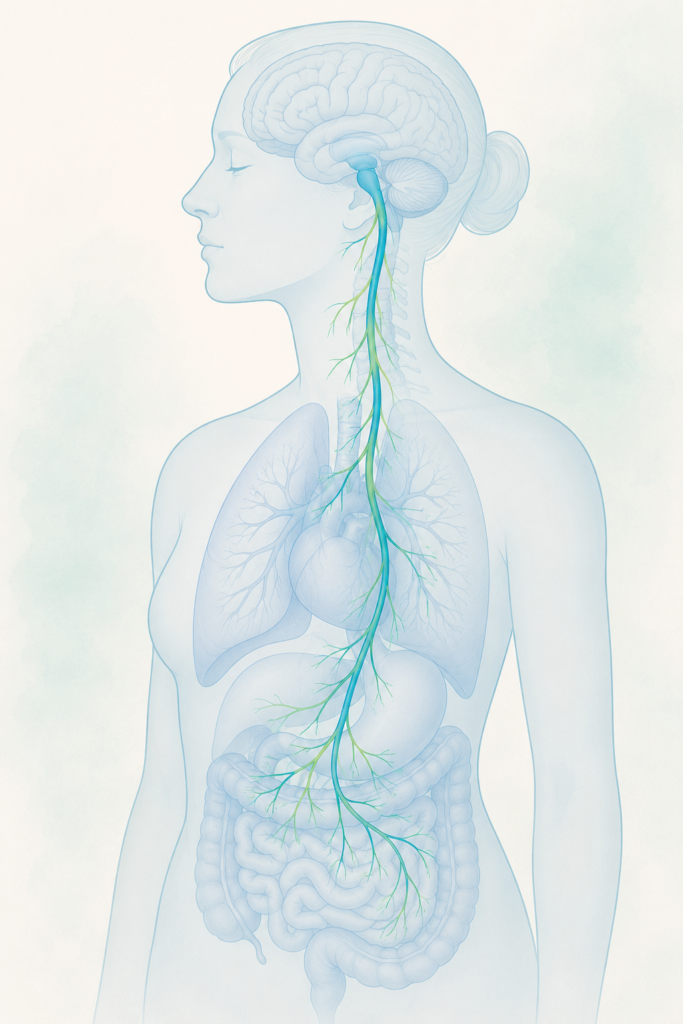
About 80% of the vagus nerve’s fibers are afferent, meaning they carry information from the body up to the brain — not the other way around. This is a key detail for yoga teachers: your body genuinely can talk to your brain and change your state. That’s the whole premise behind somatic, body-first practices like yoga, breathwork, and mindful movement.
Ventral Vagal, Explained Simply
The term “ventral vagal” comes from Polyvagal Theory, a framework developed by Dr. Stephen Porges that describes three broad nervous system states:
- Ventral vagal (safe and social): calm, connected, curious, able to breathe easily and engage with others. This is the state most yoga classes are trying to cultivate.
- Sympathetic (fight or flight): activated, alert, ready to act — racing heart, shallow breath, muscle tension.
- Dorsal vagal (shutdown or freeze): numb, foggy, collapsed, disconnected — the body’s last-resort response when fight or flight isn’t possible.
Polyvagal Theory is a widely used framework in yoga, somatic therapy, and trauma-informed movement spaces, though it’s worth noting it’s also debated among some neuroscientists regarding its precise physiological mechanisms. What matters practically for teaching is the pattern it describes: certain cues — slow exhales, soft gaze, grounding contact, gentle social engagement — reliably help people move toward a calmer, more connected state. You don’t need to resolve the scientific debate to use the tools effectively.
Why This Matters for Your Teaching
A student can be doing a pose “correctly” and still be in a sympathetic or dorsal state. Alignment cues alone don’t necessarily shift someone’s nervous system. Ventral vagal cues do something different — they work with the body’s own feedback loops to signal safety directly.
For teachers, this reframes the goal of a class: it’s not just about shapes, it’s about helping students’ physiology find its way back to a state where healing, digestion, connection, and clear thinking are actually possible.
Practical Vagus Nerve Yoga Cues You Can Use Today
1. Extend the Exhale
The single most reliable ventral vagal cue available in yoga. A longer exhale than inhale (try a 4-count in, 6–8 count out) stimulates the vagus nerve and slows the heart rate.
Try cueing: “Let your exhale be a little longer than your inhale — like you’re gently emptying a glass, not dropping it.”
2. Cue Humming or Voiced Sound
Because the vagus nerve innervates the vocal cords and throat muscles, humming, chanting “om,” or gentle voiced sighs directly stimulate it.
Try cueing: “On your next exhale, let a soft hum come out — feel the vibration in your throat and chest.”

3. Soften the Gaze and Jaw
A hard stare and a clenched jaw are sympathetic markers. Releasing them sends a safety signal upward.
Try cueing: “Let your eyes soften, like you’re looking through something rather than at it. Let your tongue rest heavy in your mouth.”
4. Offer Grounding Points of Contact
Feeling supported by the floor, a bolster, or one’s own hands activates a sense of safety and orientation — key to shifting toward ventral vagal.
Try cueing: “Feel the weight of your body being held by the floor. You don’t have to hold yourself up right now.”
5. Use Orienting Cues
A simple nervous system technique borrowed from somatic therapy: inviting students to slowly look around the room reminds the brain there’s no threat present.
Try cueing: “Take a moment to slowly turn your head and let your eyes take in the room. Notice you’re safe here.”
6. Cue Twists and Side Bends Mindfully
Gentle twists can stimulate the vagus nerve as it passes near the diaphragm and abdominal organs, but they should be layered with breath, not rushed.
Try cueing: “As you twist, lead with your exhale — let the breath initiate the movement, not the muscles.”
7. Slow, Predictable Transitions
Sudden movements or a rushed pace can cue the nervous system toward alert. Predictable pacing supports ventral vagal safety.
Try cueing: “There’s no rush here — we’ll move together, one breath at a time.”
8. End with Stillness, Not Just Silence
Savasana works best when it’s framed, not just declared. Naming that it’s safe to stop “doing” helps students actually land.
Try cueing: “There’s nothing to fix or achieve right now. Let your body finish arriving.”
A Simple Sequence Idea
A short ventral-vagal-focused arc for the end of class:
- Seated, extended-exhale breathing (1–2 minutes)
- Gentle supported twist, breath-led
- Humming or soft “om” on exhales
- Legs-up-the-wall or supported reclined pose with grounding cues
- Savasana with an orienting cue before closing
Frequently Asked Questions
What does “ventral vagal” mean in yoga? Ventral vagal refers to a nervous system state of safety and connection, drawn from Polyvagal Theory. In yoga, cueing “for ventral vagal safety” means using breath, sound, gaze, and grounding techniques that help students’ bodies register the present moment as safe.
Can yoga actually stimulate the vagus nerve? Yes — practices like slow, extended exhalation, humming, chanting, and certain gentle movements are widely used to stimulate the vagus nerve, since it’s directly connected to the breath, throat, and diaphragm. The effect is generally calming, though individual responses vary.
What is the best yoga pose for vagus nerve stimulation? There’s no single “best” pose — the mechanism is more about breath and sound than shape. That said, poses that naturally lengthen the exhale or involve gentle twisting near the diaphragm (like supported twists, legs-up-the-wall, or reclined breathing postures) are commonly used.
How do I cue for nervous system safety without overpromising results? Use invitational, sensory language rather than clinical claims. Instead of saying a pose “heals trauma,” describe what the body might notice — softening, warmth, a slower breath — and let students draw their own conclusions.
Is Polyvagal Theory scientifically proven? Polyvagal Theory is widely used in yoga, somatic therapy, and trauma-informed care as a practical framework, but some of its specific physiological claims are debated among neuroscientists. Teachers can use its language and cues usefully without needing it to be the final scientific word.
Do I need trauma-informed training to teach these cues? No, but it helps. These cues are gentle and generally safe for any class. If you plan to work more deeply with trauma-informed language or with clinical populations, additional training (such as trauma-informed yoga certification) is recommended.
Conclusion
Teaching for ventral vagal safety isn’t about adding a new gimmick to your sequencing — it’s about recognizing that the nervous system is part of every pose you cue. A longer exhale, a softened gaze, a hum on the breath, a grounded point of contact: these small, specific cues do real physiological work, helping students’ bodies shift out of alert and into a state where rest, connection, and healing are actually possible.