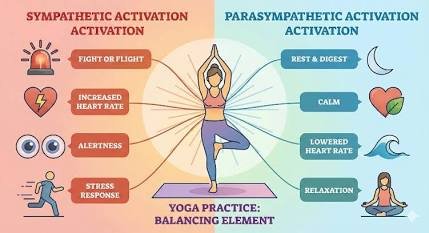
Through the Lens of Polyvagal Theory
Do you have a student who can’t find relaxation in Savasana, regardless of how gentle your voice is and how dark your lights are? Or, a student who cries during a hip opening posture, feeling awkward, like there is something “wrong” with him or her?
There’s nothing wrong at all. That student’s nervous system is simply acting as it should.
As teachers, we spend decades studying anatomy, alignment, and sequencing techniques. However, there is another powerful tool that can revolutionize our teaching – that’s the framework based on the knowledge of Polyvagal Theory and Yoga.
It gives us a new look into why certain postures create particular bodily responses in our students, and how we can work with them to reach their full potential.
This blog is a guide through Dr. Stephen Porges’ innovative Polyvagal Theory and Autonomic
Ladder principles and how to apply them in your classes.
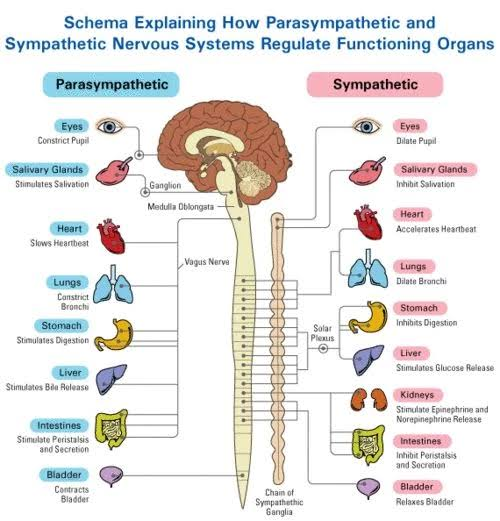
What Is Polyvagal Theory? A Primer for Yoga Teachers
Polyvagal Theory, introduced to the world by Dr. Stephen Porges, a neuroscientist, in 1994, was a game-changer in our understanding of the autonomic nervous system (ANS). Before Porges, most people believed that there were only two parts of the ANS: the sympathetic (fight-or-flight) and the parasympathetic (rest-and-digest). What Porges found, however, was something more sophisticated, and for trauma-informed yoga instructors something more useful.
What he found out was that the vagus nerve (the largest cranial nerve, which runs from the brainstem down to our heart, lungs, and guts) has two branches:
- The Ventral Vagal Pathway (myelinated, new): Connected with social engagement, safety, connection, and regulation. This is our “rest and connect” part.
- The Dorsal Vagal Pathway (unmyelinated, old): Associated with collapse, shutdown, dissociation, and freezing. This is a survival mechanism used if we perceive danger as insurmountable.
- The Sympathetic State: Located between the two vagal states and controls mobilization.
In total, these three states make up what is commonly known as the Polyvagal Ladder or autonomic hierarchy.
The Autonomic Ladder: A Map for Yoga Teachers
It’s important to imagine the nervous system as a three-tier ladder.
- Upper Tier — Ventral Vagal (Safe & Social)
- State: Relaxing, connected, present, curious, receptive.
- Physiological indicators: Controlled breathing, relaxed facial muscles, eye contact, able to receive touch, smooth vocal tones. In a yoga setting: This student can be guided in class, try out new postures, relax in Savasana, and reap the benefits of breathwork.
Middle Rung — Sympathetic (Mobilized)
- States: Fight, flight, anxiety, hypervigilance, restlessness. Physical symptoms: Fast breathing, tight jaw, looking around the room, inability to sit still, trembling, irritability. In yoga class: This student might be squirmy, resistant, unable to relax, or overreacting to certain instructions or physical touch.
- The Lowest Rung – Dorsal Vagal State (Collapsed) State: Shutoff, dissociation, numbness, freeze, disconnection.
- Physical Symptoms: Glassy-eyed, flat expression, lack of response, very fatigued, inability to make decisions. In yoga class: This student might appear “zoned out,” fall asleep in class, or struggle to sense their own body at all.
- Polyvagal theory combined with yoga becomes powerful when you recognize these states in your students, because you no longer take things personally – you make it therapeutic.
Why Traditional Yoga Cues Can Miss the Mark
The majority of classic yoga teacher trainings prepare a yoga teacher with only one way to work — one speed, one energy, and one sequence for everyone. However, a person who has slipped into the state of dorsal vagal shutdown is not going to benefit from the intervention used by a person operating in sympathetic arousal.
Red flags that could potentially escalate a situation:
client; relaxing could mean further detaching from their body.
● “Close your eyes” — A client in hypervigilance, taking away visual stimuli from the room, might trigger a fight-flight response.
● “Challenge yourself, push through the discomfort” — Trauma survivor, pain, and discomfort will never be indicators for growth.
● “Breathe deeply” — Strong inhaling could worsen already dysregulated physiology.
Knowing about Polyvagal Theory and Yoga Theory means that you have to rewrite the entire cueing protocol in your yoga practice. It is one of the greatest gifts a trauma-informed yoga teacher training program can give.

How to Apply Polyvagal Theory in Your Yoga Classes
And here’s where both Polyvagal Theory and Yoga become useful. Here are evidence-based strategies that will assist you in designing nervous system–conscious classes:
1. Self-Regulation First
5 minutes of self-regulation before the start of the class – deep breathing, humming, rooting through the feet. The co-regulatory environment is contagious. You can’t expect a regulated room without a regulated teacher.
2. Predictability in Class
Most likely, trauma survivors operate in an unpredictable environment. Bring predictability to your classes – predictable structure, rituals, announcements of what is to come next.
3. Make Choices Available
Provide choices rather than giving orders: “You could try…” and “You may decide… depending on how you feel.” Autonomy is the remedy for the sense of helplessness, which is the hallmark of trauma.
4. Use Exhale-Extended Breathwork
Lengthy exhalations engage the ventral vagal system, calming the sympathetic nervous
system. An inhale-to-4, exhale-to-6-8 breath technique is an effective method for almost
everyone. Do not use strong Kapalabhati or breath retention in a mixed group.
5. Ground Students in Somatic Experience
Encourage students to connect through their body awareness: Feel the sensation in your hands. Experience the warmth or coolness of the air touching your skin. It is a way to promote somatic experience without delving into emotional content.
6. Observe Your Class
If students look tense and alert, they could be stuck in their sympathetic nervous system. Slow down your practice, offer grounding postures. If students appear distracted and numb, it is possible that they are in their dorsal collapse state.
Why Yoga Teachers Need Polyvagal Theory in Their Training
In a course where you are training or creating trauma-informed yoga teacher training, Polyvagal Theory cannot be added as an optional segment but must be integral to the program. Here are some reasons for it:
- Yoga impacts the nervous system. All asanas, pranayamas, and sound vibrations are inputs to the nervous system. If we do not have knowledge about how the nervous system responds to these inputs, we will be teaching without knowledge.
- The incidence of trauma is quite high. Studies confirm the same: a vast majority of individuals suffer from one or more types of trauma. In a classroom of 15 people, there will be trauma survivors regardless of whether we know who they are.
- Intention alone does not suffice. There are many instances wherein the good intentions of yoga teachers have ended up traumatizing their students through unnecessary adjustments, aggressive language use, and poses that require students to stay absolutely still.
- Both Yoga and Polyvagal Theory offer us a vocabulary to comprehend our existence at a deep, pre-conscious level.
The Yogi-Science Connection: What the Ancients Knew
Notably, Yogic thought has recognized this for some time. The idea of Prana (the life force)
flowing through Nadis (channels) echoes the scientific recognition of the vagus nerve as the
two-way communication link between body and brain.
- The throat and its associated Udana Vayu energy flow upwards, which fits perfectly with the
- Social Engagement System – the face, voice, and ears. The downward and releasing function of
- Apana Vayu matches the parasympathetic response. The two systems are not opposing forces.
- Rather, they are different ways of expressing the same phenomenon.
Frequently Asked Questions (FAQs)
Q1: Is it necessary for me to have a background in psychology to teach Polyvagal
Theory-based yoga?
Not really. You are neither supposed to be a therapist nor pose to be one. Rather, what is
expected of you is that you have at least some basic knowledge regarding how your body’s
autonomic nervous system works and how to provide safety and support through it. In your
training as a trauma-informed yoga instructor, you will learn how to do so.
Q2: How is Polyvagal Theory and Yoga different from other kinds of yoga?
Where traditional yoga trainings tend to focus mostly on the correct alignment of your postures. Sanskrit terms, and how to put together sequences, trauma-informed training adds the neurobiological aspect to yoga practice. Thus, besides learning how to align students’ bodies correctly, your primary concern as a trauma-sensitive instructor would be how to read students’nervous system states, co-regulate them, adapt your language and tempo, and most importantly, prioritize psychological safety.
Q3: Can Polyvagal Theory-informed yoga help students with PTSD or
anxiety disorders?
Yoga, rooted in the theories of the Polyvagal System and Yoga practice, could be an effective
supplement to clinical interventions for patients with post-traumatic stress disorder, anxiety,
and similar ailments – but not a substitute for therapy. Studies conducted by Dr. Bessel van der Kolk and others have confirmed that body-centered approaches fostering interoception and self-awareness could contribute significantly to the healing process of such patients.