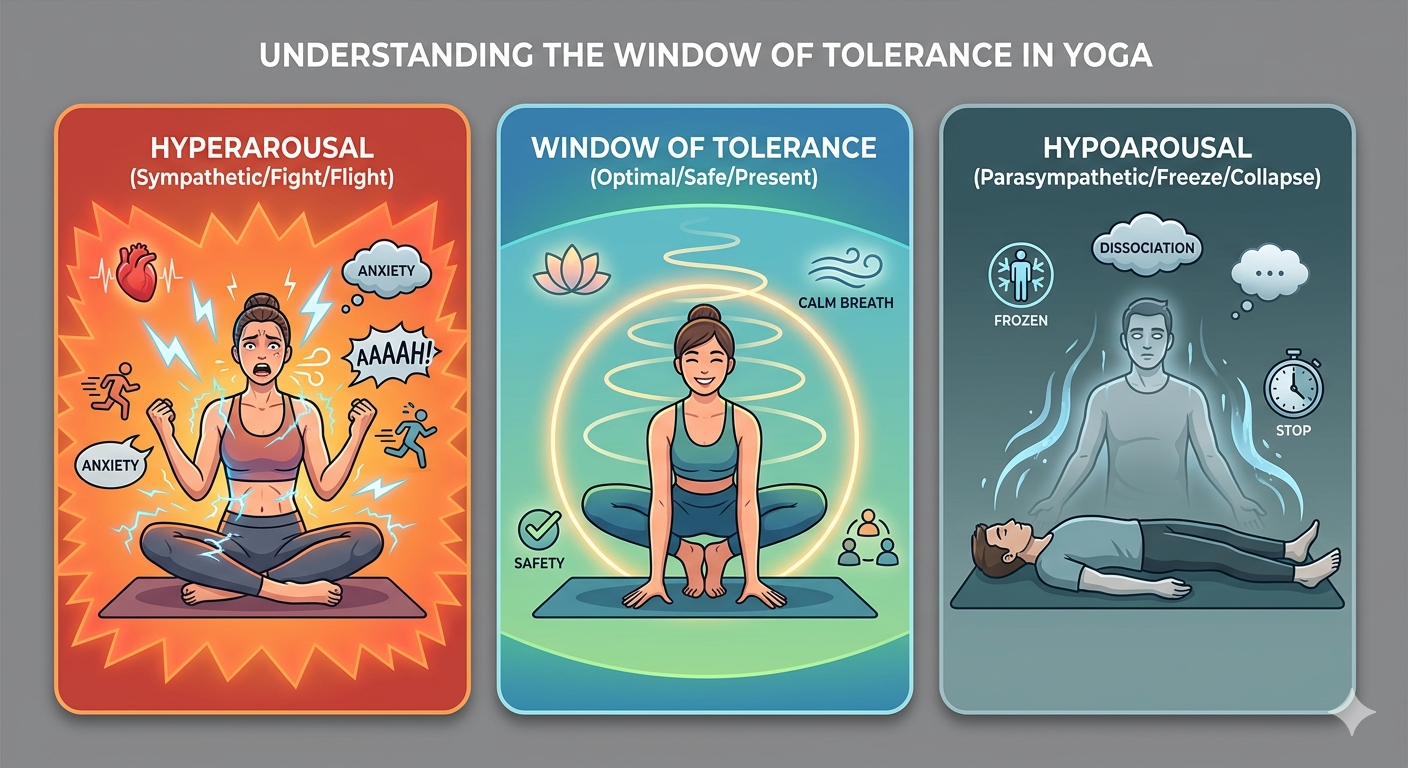
What to do when a student dissociates or panics on the mat. Understanding the yoga window of tolerance can help teachers support their students in these moments.
It is common knowledge that yoga classes are considered safe places for healing, self-exploration, and regulation of the nervous system. But for some students who are struggling with stressful situations or dealing with trauma, anxiety, burnout, or an unfinished psychological experience, the mat can become a space where intense feelings emerge.
For example, a student freezes during savasana. Or starts breathing fast while opening the hips. Another student looks distracted, out of focus, or emotionally withdrawn during meditation. Although yoga instructors are not therapists, sometimes they can be in a unique position to see when a student moves out of the normal window of regulation in their nervous system.
In other words, this is where the Window of Tolerance comes into play.
By recognizing the symptoms of both hyperarousal and hypoarousal, yoga teachers can learn how to run trauma-sensitive classes and assist a student experiencing dysregulation.

What Is the Window of Tolerance?
“Window of Tolerance” was a term coined by psychiatrist Dr. Dan Siegel to define an ideal range of nervous system regulation, which allows an individual to work effectively, learn, and be emotionally present.
When students are in this “window,” they can:
- Connect with their breathing and body
- Handle stress without overreacting
- Maintain emotional balance
- Participate in classes without being stressed out
- Experience difficulties without shutting down
Being inside the window, the nervous system experiences relative safety.
Yet, if stress, trauma triggers, physical pain, or emotions get too overwhelming for the person, then the nervous system might find itself outside the “window” either in:
Hyper-arousal state (fight/flight mode)
Hypo-arousal state (freezing/shutting down).
Recognizing these states allows teachers to treat them with compassion and not frustration.
Why Yoga Can Trigger Nervous System Responses
Yoga is an embodied practice. Unlike other fitness spaces, yoga invites one’s attention, stillness, breathing, and emotions. This can be cathartic, but it could also bring up stored trauma reactions.
Certain elements in yoga practice may unconsciously dysregulate:
- Hands-on adjustments
- Closing one’s eyes
- Holding one’s breath
- Deep hip or back opening
- Silence
- Dark room or loud music
- Being stuck in a pose
- Mystical language that doesn’t address emotions
- Pressure to relax/let go
Survivors of trauma can perceive stillness and vulnerability as dangerous rather than safe.
It does not mean that yoga is bad. It means it’s helpful for instructors to understand how the nervous system operates.
Recognizing Hyperarousal in a Yoga Student
Hyperarousal is an overstimulation of the sympathetic nervous system. The fight or flight response. An individual in hyperarousal will seem anxious, scared, fearful, or overwhelmed.
Common Signs of Hyperarousal
They include:
- Hyperventilation or holding one’s breath
- Shaking or trembling
- Fearfulness or panic
- Inability to sit still or fidgeting
- Excessive crying
- Fast heartbeat
- Sweating
- Hypervigilance
- Impulse to leave the room
- Irritation or anger
- Easily startled
- Inability to follow directions
Sometimes the signs might be more subtle and include constantly moving around and an inability to relax into Savasana.
What Hyperarousal Can Feel Like
It includes statements like:
- “I don’t feel safe.”
- “I must escape.”
- “Something terrible is happening.”
- “I cannot calm myself.”
- “I am stuck here.”
Although the setting might seem peaceful, the nervous system perceives threats.

Recognizing Hypoarousal in a Yoga Student
Hypoarousal is at the other end of the nervous system scale and is linked to the freeze, collapse, or shut-down reaction.
Here, instead of being too activated, the body goes into hypo-aroused mode.
This condition is frequently misinterpreted since it can come across as relaxed states, which are actually dissociated states.
Common Signs of Hypoarousal
Symptoms include:
- Blank stare
- Detached or distant expression
- Unemotional demeanor
- Sudden tiredness
- Delayed response
- Inability to focus on the surroundings
- Sluggish body language
- Trouble speaking
- Looks dazed or spaced out
- Feels faint or dizzy
- Unengaged behavior
- Unnatural physical movements
- Completely immobile
A child may be outwardly calm but inwardly detached or absent-minded.
What Hypoarousal Can Feel Like
Internally, a student might experience:
- “I don’t feel anything.”
- “I’m just floating.”
- “I’m disconnected.”
- “I can’t move.”
- “I’m miles away.”
Dissociation in Yoga Class: What Teachers Need to Know
Dissociation occurs in degrees. Mild dissociation is relatively frequent; for example, spacing out while driving. Trauma-induced dissociation can be marked by detachment from one’s body, feelings, and even reality. During yoga classes, dissociative states may occur during the following practice phases:
- Deep relaxation
- Meditation
- Pranayama
- Holding poses
- Yoga asanas evoking deep emotions
Signs of dissociation include an abrupt stop of response and blank stares at instructors or the space ahead. The crucial thing to keep in mind is that:
Dissociation is not laziness or resistance. It is a defense mechanism.
Instructors need to be careful about interpreting such behavior as unwillingness or spiritual resistance.
Trauma-Sensitive Yoga Principles
You don’t have to be a trauma therapist to teach more safely. There are some small language changes that can make a big difference.
1. Prioritize Choice
People with a history of trauma lose control in their lives. Giving them a choice gives back that control.
Replace:
“Close your eyes.”
with:
“If it feels right for you, you can softly close your eyes.”
Replace:
“Stay in the pose.”
with:
“You may stay in the pose, come out of it, or rest whenever you choose.”
2. Use Invitational Language
There may be moments where command style feels activating to certain students.
Do NOT say:
- “Notice how you feel.”
- “Examine the feeling.”
- “You are allowed…”
Do say:
- “Keep going!”
- “Finish strong!”
- “Dig deep!”
A trauma-sensitive approach prioritizes curiosity over results.
3. Avoid Forced Stillness
While stillness is calming for some, it might be scary for others.
Provide opportunities for movement:
- Soft rocking
- Posture changes
- Being upright
- Sitting instead of lying down
4. Ask Consent for Physical Adjustments
Assisted support should never be taken for granted.
Always remember to:
- Seek consent
- Consider body language
- Encourage saying no
Even gentle physical touch may activate the survival response in an individual.
5. Create Predictability
Predictability creates safety for the nervous system.
This can be achieved through:
- Explaining class dynamics
- Providing a warning before transitions
- Using consistent pacing
- Minimizing any loud noises
A predictable setting allows students to remain in their window of tolerance.
What to Do If a Student Panics on the Mat
If a student becomes panicked or very distressed during class, you are not there to problem-solve or interpret what’s happening. Rather, you are there to support grounding and regulation.
Step 1: Stay Calm Yourself
As the teacher, your nervous system impacts the room.
Speak calmly and quietly. Try not to be frantic or alarmed.
A regulated teacher helps co-regulate the students.
Step 2: Reduce Stimulation
Guide the student to:
- Sit up straight
- Open his/her eyes
- Scan the room
- Pay attention to outer stimuli
Say things like:
- “You’re in the studio.”
- “Go at your own pace.”
- “Feel your feet touch the floor.”
Step 3: Encourage Gentle Breath Awareness
Do not push for forced deep breathing since it may actually cause the panic attack to become worse.
Try:
“Feel your natural breath.”
“Can you extend your breath a little bit on the exhale?”
These gentle instructions will be most effective.
Step 4: Offer Choice
Say:
- “Would you like something to drink?”
- “Would you rather step outside?”
- “Would sitting down be better?”
A choice will empower the person.
Step 5: Respect Boundaries
Do not:
- Touch without permission
- Inquire about personal information
- Force processing of emotions
- Make a scene of the child
What to Do If a Student Dissociates
Dissociation requires gentle connections, not force.
Helpful Grounding Techniques
Recommendations:
- Sense feet on the mat
- Feel your hands against each other
- Name items around the room
- Hold a blanket or a block
- Gentle movement
- Open eyes
- Focus on fixed visual points
It should be done in a way that encourages sensory awareness.
What Not to Do
Don’t:
- Give forceful commands
- Approach them suddenly
- Tell them to snap out of it
- Ask about their feelings in class
- Assume they feel relaxed
Dissociation is usually a coping mechanism.
Building a Trauma-Aware Yoga Environment
Trauma-sensitive instruction does not involve fear tactics. It is about making sure that there are ways for more people to engage safely.
Consider These Class Elements
Room Setup
- Ensure access to exits
- Do not crowd the room
- Provide comfortable lighting
Language
- Stay neutral and inclusive
- Do not shame or embarrass
- Do not make judgments on the body
Music & Sound
- Control the volume
- Avoid loud transitions
Sequencing
- Alternating activation with grounding
- Rest during class time
- Mindful of holds
Savasana Alternatives
- Some alternatives include:
- Side-lying relaxation
- Seated meditation
- Bent knees
- Omitting savasana entirely
When to Refer Out
A yoga instructor is not a mental health professional unless he or she holds a separate certification for such qualifications.
If a student:
- Has frequent panic attacks
- Has traumatic past experiences
- Dissociates often
- Seems unstable
- Needs psychological assistance
Then it may be necessary to advise him or her to seek professional assistance.
One can still show compassion without becoming a counselor.
The Importance of Teacher Self-Regulation
Yoga teachers also need to be trauma-aware and self-aware.
If a teacher feels overwhelmed, dysregulated, or emotionally depleted themselves, responding to a client who becomes triggered will be very difficult for them.
Take care of yourself by doing the following:
Rest
- Having supervision or a mentor
- Personal psychotherapy, if you require it
- Maintaining boundaries
- Ongoing education
- Your grounding techniques
It takes a regulated teacher to create a regulated environment.
Going Beyond “Good Vibes Only”
The current culture of wellness can overvalue positivity at the cost of understanding nervousness
system dysregulation.
Examples such as:
- “Just breathe.”
- “Release the negativity.”
- “Relax.”
…can dismiss the experience of a student whose body does not yet feel safe enough to relax.
Yoga window of tolerance understands that being able to regulate yourself is not about forcing calm.
Conclusion on Yoga Window of Tolerance
The Yoga Window of Tolerance gives yoga instructors a great tool to understand their students’ neurology when practicing in the classroom. When their students go into hyper-arousal or hypo-arousal, they are not doing yoga wrong—their nervous systems are giving them a great message.
By being able to spot when their students experience symptoms of panic, disassociation, numbness, or feeling overwhelmed, yoga instructors can react in a more caring and professional manner. A few tweaks in their language, timing, permissioning, and grounding will make huge leaps towards making their students feel emotionally secure in the classroom.
The power of yoga to help with trauma is very powerful. Trauma-conscious yoga instruction, however, should start by providing a space where the students feel secure enough to connect with themselves.
FAQs on Yoga Window of Tolerance
1. Define the Yoga Window of Tolerance.
The Yoga Window of Tolerance represents a state in which a person’s nervous system is regulated and feels sufficiently safe to practice yoga without being overly excited or shutting down.
2. Define hyperarousal in yoga.
Hyperarousal is a fight/flight response of the nervous system that manifests as fear, anxiety, shallow breaths, agitation, or emotional flooding during a yoga class.
3. Define hypoarousal or dissociation in yoga.
Hypoarousal describes a shutdown or freeze reaction of the nervous system, resulting in a student appearing numb, detached, spacey, or dissociated from the mind-body connection.
4. Is it possible for a person practicing yoga to experience a trauma response?
Yes. Practices involving breath work, quieting the mind, body touch, vulnerable poses, or deep inner work have been known to induce stress reactions in some students.
5. Should yoga teachers identify mental health conditions in students?
No. It is unethical and inappropriate for yoga teachers to diagnose mental illnesses. However, they can ensure safety, provide grounding resources, and refer clients to professionals when needed.
6. What do I do if a student goes into a panic attack during class?
Be calm, minimize stimulation, encourage grounding, provide options, and don’t make the person breathe deeply or talk about their emotions. Facilitate grounding by encouraging the student to connect with the present moment.
7. What changes can be made to yoga classes to ensure greater sensitivity around trauma?
Teachers can practice consent-based adjustments, invite students to participate, establish clear routines, offer modifications, and facilitate grounding.
8. Is savasana potentially triggering to trauma survivors?
Yes. The stillness, closing of the eyes, and vulnerability of the savasana pose could trigger individuals who’ve experienced trauma. Alternative resting poses can be considered.