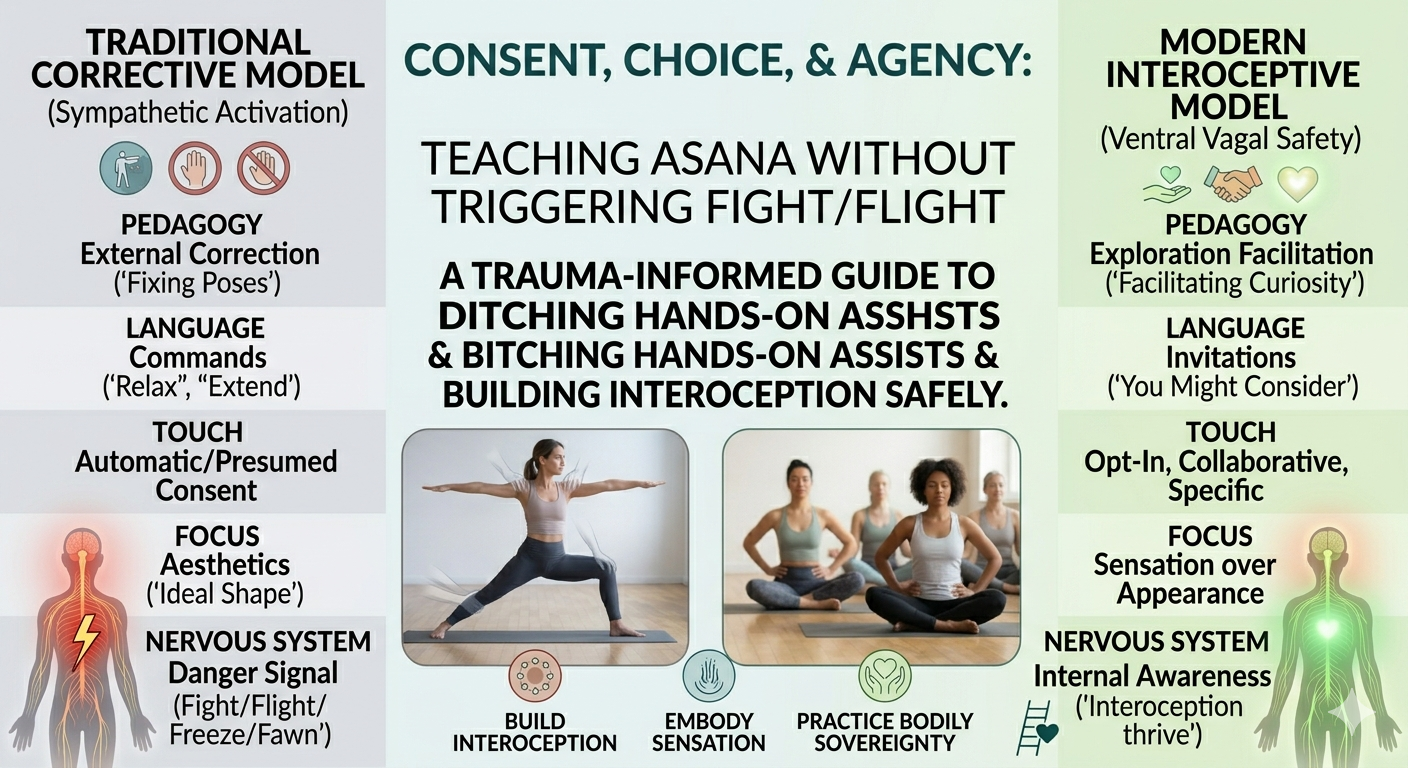
Ditching hands-on assists and building interoception safely is a central aspect of trauma informed yoga assists.
Yoga classes are changing. Traditional approaches to teaching yoga, such as walking through the room and guiding students into ‘alignment’ via physical contact, are beginning to be challenged in light of increased awareness around trauma, nervous system regulation, consent, and body sovereignty.
Physical assistance techniques have been taught as one of the hallmarks of effective teaching for many years now. Teachers have become experts at manipulating bodies into deeper postures, assuming that the tactile input helped students achieve better alignment or made their practice safer and more pleasurable. However, contemporary neuroscience and movement education offer an interesting perspective: that unconsented physical touch could elicit stress responses rather than promote embodiment.
Many students enter a classroom with some form of history. This history may take the shape of any or all of the following: stress, burnout, anxiety, hypervigilance, past medical trauma, cultural influences, or any other form of physical violation.
This does not imply that touch is inherently dangerous. This implies that yoga teachers need to be deliberate in their approach to issues of consent, autonomy, and nervous system safety.
The best teachers of today have moved on from correctionist pedagogy to practices focused on interoception—learning how to listen to internal physical cues. Rather than instructing what the asana should look like, teachers now teach students what happens in their body.
This redefines yoga from an act of performance into one of relationship.
This gives students the power to determine what works for them.
But more than anything else, it turns yoga classes into spaces that practice safety rather than assuming it.
Understanding the Fight/Flight Response in Yoga Spaces: The Need for Trauma-Informed Yoga Assists
The nervous system is continually assessing its surroundings to detect safety or threat. Neuroception is the term used to describe this phenomenon, which takes place outside one’s consciousness.
Threat perception triggers survival responses such as:
- Fight – resistance, irritation, defensiveness
- Flight – anxiety, urgency, need to run away
- Freeze – numbness, disassociation, immobilization
- Fawn – compliance, people pleasing
The yoga teacher may think, “All I’m doing is adjusting their shoulders,” while the student experiences unexpected physical contact as a threat response.
Why does this matter?
Students rarely protest against inappropriate touch because survival states prevent the expression of speech, boundaries, and rational thinking. Students freeze or comply automatically due to a power imbalance caused by the expert nature of the teachers in authority-driven scenarios.
In conclusion, no silence can ever equal consent.
Trauma-informed practice understands that alignment is secondary to nervous system well-being.
Why Traditional Hands-On Assists Are Being Reconsidered
In the past, many traditions in yoga accepted physical contact as a means of instruction. The instructors would receive training to “correct” postures by manipulating the body, increasing stretch, or performing advanced postures.
The following issues have come up:
1. Consent Is Often Presumed Instead of Obtained
Just because someone comes to class does not mean they are giving consent to be touched.
Even things like consent cards and classroom announcements can become issues if one feels pressured to consent to prove cooperation with yoga practice.
Real consent must be:
- Voluntary
- Revocable
- Informed
- Specific
- Enthusiastic
2. External Correction Can Reduce Body Awareness
When students depend on teachers to align their bodies correctly, they risk becoming detached from interoceptive sensations.
They stop asking questions like:
- “What is it that I am feeling?”
- and start asking:
- “Am I doing it correctly?”
The practice of yoga becomes more about external achievement than internal awareness.
Interoception becomes weaker when students neglect internal signals in favor of external guidance.
3. Everybody Experiences Sensation Differently
There are no cookie-cutter bodies.
Bone structure, range of motion, previous injuries, neurodivergence, variations in connective tissue, disability, and emotional state affect movement potential.
- What grounds one student might be invasive to another.
- What supports another body may cause pain for someone else.
- A trauma-informed educator realizes there is no such thing as an “ideal shape.”
- What is Interoception and Why Is It So Important?
Interoception is knowing how one’s internal body works; that includes experiencing physical feelings like:
- Breath
- Muscle tension
- Temperature
- Heart rate
- Pressure
- Fatigue
- Emotion
- Hunger or satiety
- Comfort or discomfort
It is the key to self-regulation and embodiment.
Well-developed interoception will help students:
- Understand their limits
- Catch their stress responses sooner
- Distinguish between discomfort and danger
- Gain trust in themselves
- Manage emotions better
- Move with intention rather than compliance
In trauma-sensitive yoga, fostering interoception takes precedence over alignment.
Instead of asking:
- “Can the student execute the asana?”
- We start thinking about:
- “Can the student stay present with themselves when moving?”
- This is huge.
How to Offer Trauma-Informed Yoga Assists: 5 Practical Strategies
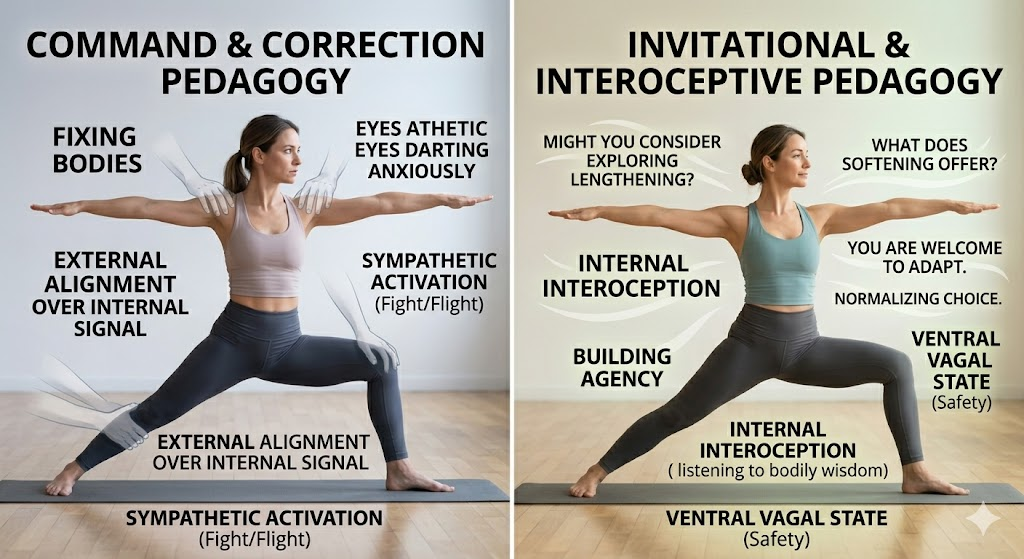
1. Replace Commands with Invitations
Language impacts nervous system responses.
Direct language inadvertently promotes hierarchy and compliance.
In place of:
- “Extend your leg.”
- “Release your shoulders.”
- “You will experience this sensation right here.”
Consider:
- “Might you consider exploring leg lengthening?”
- “What does shoulder softening offer?”
- “Do you notice support in this variation?”
The shift to invitation creates an empowered experience for students.
Students continue to be active within the process.
2. Normalize Choice Constantly
Choice must be continuous – not intermittent.
- Students need to be told regularly that:
- Rest is okay
- Modification is okay
- Choosing not to participate is okay
- Having different sensations is okay
- Moving on from an asana is okay
Some examples are:
- “Feel free to remain in that place.”
- “You are welcome to adapt that shape to suit yourself.”
- “There isn’t a ‘deepest’ form of this asana.”
- “It’s perfectly fine to rest at any time.”
As choice is made an ongoing theme, students begin to trust themselves once again.
3. Demonstrate Rather Than Manipulate
Demonstration can work better than correction.
- Teachers can:
- Offer variations on asanas
- Use props openly
- Demonstrate different alternatives
- Teach through verbal cuing
- Facilitate self-exploration
Students are able to discover asanas rather than simply correct positioning.
4. Teach Sensation Over Appearance
In many yoga traditions, aesthetics reign supreme:
- Perfect lines
- Deep postures
- Complex forms
- Trauma-sensitive approaches emphasize awareness instead.
- Where traditional yoga might instruct:
- “Go deeper into the pose.”
- Consider instead:
- “See where you feel grounding, effort, or ease.”
- Awareness takes priority over achievement.
5. Avoid Using Touch as a Shortcut
- Verbal instructions can seem slow compared to hands-on assistance.
- But “slow” does not equal “bad.”
- Self-discovery is the key to sustainable embodiment.
- It may take more time, but it builds independence, not dependence.
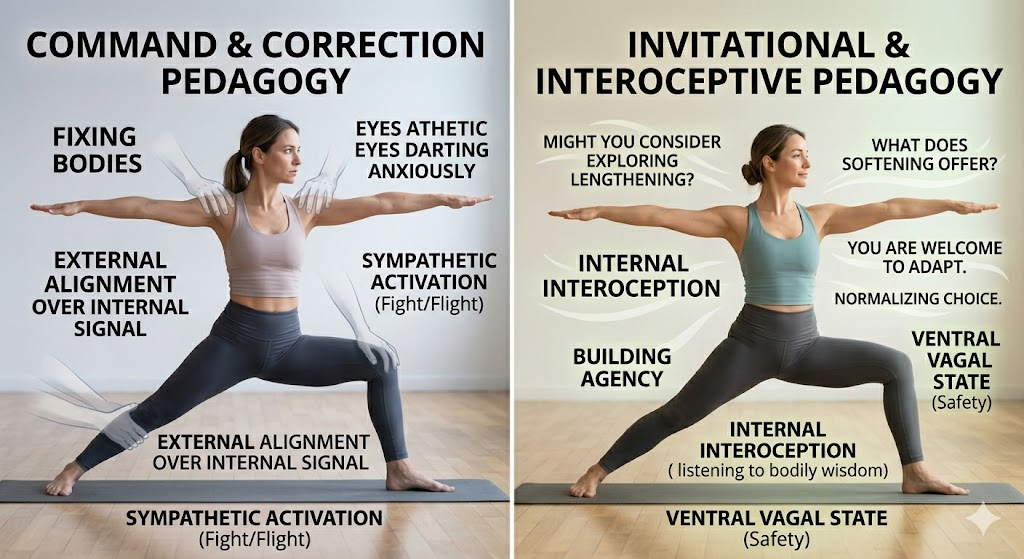
The Problem with “Fixing” Bodies
A corrective approach often suggests:
- The teacher holds all the answers
- The student’s body needs correction
- Dyscomfort must be overcome
- External validation is preferable to internal wisdom
- This kind of messaging can cultivate shame and disconnection.
- Students already live in bodies constantly critiqued and shamed:
- “Sit properly.”
- “Be thinner.”
- “Stand taller.”
- “Do more work.”
- “Ignore the pain.”
Yoga need not perpetuate this cycle of shame and fear.
Yoga can become an exercise in non-judgmental self-exploration instead.
Building a Consent-Centered Classroom Culture
It is not simply a question of asking:
“May I work on you?”
It is about creating a learning environment where the value of autonomy is clear.
Key Elements of Consent-Centered Teaching
- Transparent Communication
Explain what the purpose of touch will be before starting class.
- Opt-In Rather Than Opt-Out
The touch should be chosen, not avoided.
- Non-Punitive Choice
A student should not be picked on for not wanting help.
- Reading Nonverbal Cues
Hesitation, stiffness, pulling back, or silence can signal that a student feels uncomfortable.
- Respecting Changed Minds
Consent now does not mean consent later.
Why Agency Is Healing
Agency refers to the feeling of having control over your own actions.
Trauma frequently destroys the sense of agency.
We learn that:
- Our no doesn’t matter
- Our body isn’t ours
- It’s better to conform than to be genuine
Practicing yoga could either strengthen this dynamic or heal it.
When students are taught to:
- Take a break
- Adapt
- Say no
- Investigate their experience
- Relax
- Express themselves
The restoration process of embodiment begins.
It is particularly effective when done by traumatized students.
The practice ceases to be about physical achievements but instead about regaining the connection with oneself.
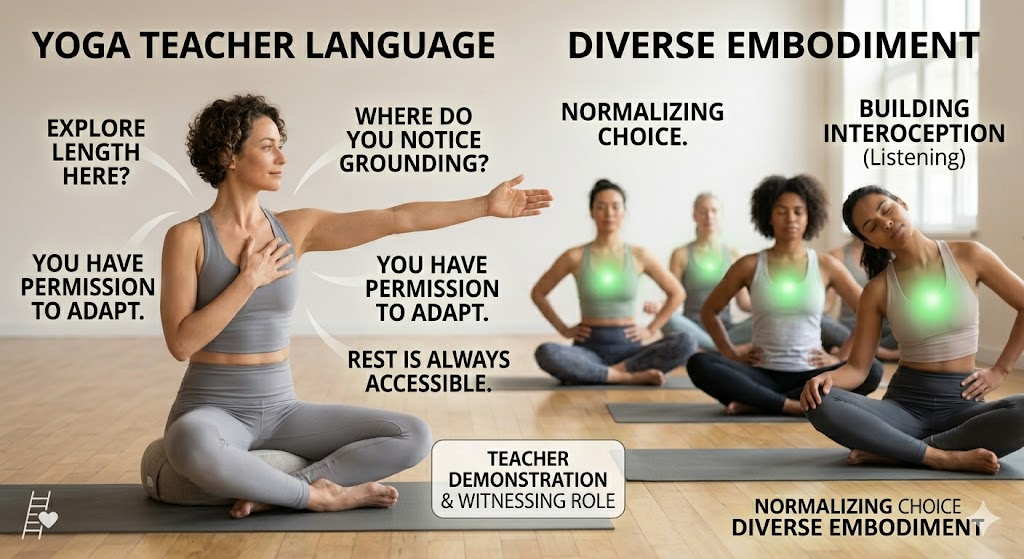
Reimagining the Role of the Yoga Teacher
The modern yoga teacher is not a body mechanic.
Their job is not to shape students into perfect bodies.
Rather, they are:
- Exploration facilitators
- The nervous system guides
- Embodied curiosity advocates
- Safer space keepers
- Witnesses and not directors
And humility is needed to embody such a role.
The teacher doesn’t need to “perfect” every pose.
Many times, the best way to teach is by letting the students explore their practice without imposing anything upon it.
When Touch Remains Appropriate
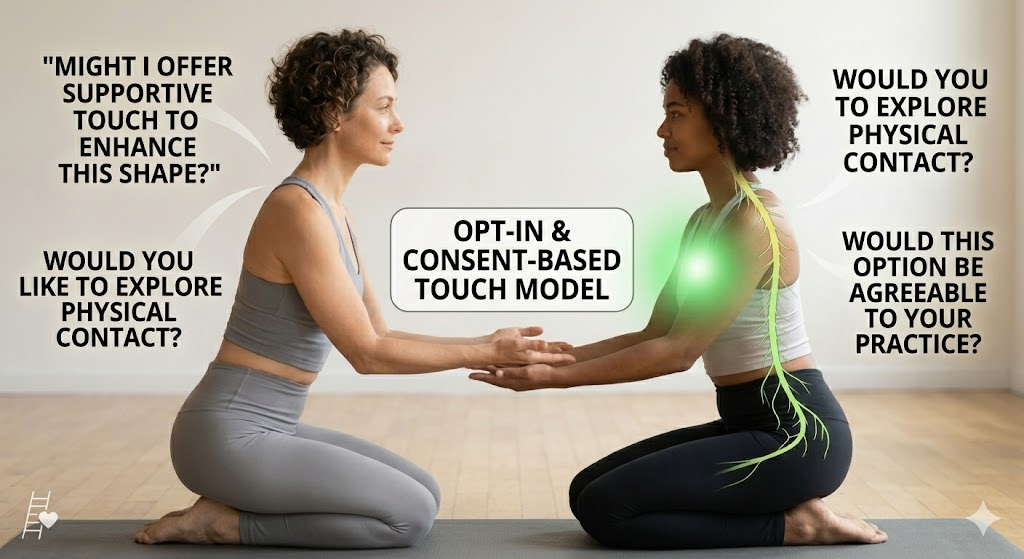
Trauma-informed teaching does not mean that we must stop touching our students.
Touch may remain meaningful when:
- Explicit consent has been obtained
- There is a clear goal
- Alternatives exist
- The power imbalance is recognized
- Consent may be withdrawn easily
For some students, supportive touch can be calming.
But the crucial difference is this:
The act of touching must become a collaboration and not an assertion.
It becomes something given and not imposed.
Creating Safer Yoga Spaces for the Future
Teaching yoga in the future is not about stricter enforcement of alignment, nor about ever more complex sequencing.
It is about relationship safety. People will remember how a teacher made them feel much more than if they had Warrior II perfect.
A safe classroom environment:
- Lowers performance anxiety
- Promotes self-awareness
- Regulates the nervous system
- Affirms bodily sovereignty
- Holds space for diversity
- Honors humanity over aesthetics
This progression does not undermine the practice of yoga teaching. It enhances it. Yoga fundamentally is not about external perfection. It is about connection.
Conclusion: The Future of Empowerment and Trauma-Informed Yoga Assists
Choice, consent, and agency are not simply buzzwords in contemporary yoga but foundational elements necessary for ethical teaching.
As understanding expands regarding trauma, nervous system regulation, and embodied safety, yoga instructors are being encouraged to rethink past ideas of authority, correction, and physical adjustment.
Shedding automatic hands-on assists doesn’t mean losing effectiveness; in many instances, it increases effectiveness by allowing students to develop their interoception, trust, and embodiment.
When yoga teachers focus on inner awareness rather than outer appearance, yoga becomes more welcoming, more inclusive, and more transformational.
Students don’t practice yoga to please the instructor with their form.
They practice yoga to build a deeper connection with themselves.
And in a world where people learn to separate from their body as a means of survival, such a connection could be one of the most profound gifts we have to offer.
FAQ on Trauma-Informed Yoga Assists
1. Why are physical adjustments falling out of favor in modern yoga classes?
Physical adjustments are being reconsidered as unintentional and unconsensual touch may provoke a stress response in some people. Trauma-informed practice promotes nervous system safety, consent, and personal agency over physical corrections.
2. What is interoception in yoga?
Interoception means awareness of internal sensations like breathing, muscle tension, heart rate, temperature, and emotions. The development of interoception allows practitioners to develop self-awareness, trust, and emotional regulation during a yoga session.
3. Is it ethical for a teacher to use physical touch in a yoga class?
Yes, touch can be an ethical practice if both explicit, informed, and enthusiastic consent has been given. It should be possible for a student to refuse or retract their consent without fear of consequences.
4. How can a teacher ensure alignment without touching his/her students?
Verbal descriptions and directions, demonstrative approach, the use of props, modeling, and invitations can be employed by a teacher. Sensory exploration, rather than forceful adjustment of postures, creates safer teaching.
5. What would a trauma-informed yoga class look like?
In such a class, emphasis is placed on consent, choice, nervous system safety, and inclusivity. The use of coercion-free language, normalizing modifications and rest, non-coercive approaches to physical adjustments can be seen here.