Why stillness can be threatening and how to offer options. In this post, we’ll explore why savasana can feel unsafe for some people and discuss ways to create a more supportive environment.
Savasana, for many yoga teachers, is known to be the most serene and beneficial pose. Commonly referred to as the “final relaxation,” it is viewed as a spiritual practice of integration, quietude, and nervous system restoration. Yoga practitioners lie on their backs, with eyes closed, their bodies in a motionless position amidst soothing sounds of calming music.
However, what if stillness is not safe?
What if relaxing by closing one’s eyes and letting go feels unsafe?
For individuals who have experienced any type of trauma in their lives, the practice of Savasana could become a rather stressful experience. Instead of allowing oneself to relax, one could find oneself feeling stuck, alert, vulnerable, dissociated, or flooded with emotions.
As knowledge of trauma-sensitive practices becomes increasingly widespread, there is a certain realization that relaxation is not an experience for everyone; safety comes first.
It does not necessarily mean that Savasana should no longer be practiced in classes.
Why Savasana Can Feel Unsafe
In order to explain how Savasana could cause discomfort for certain individuals, it is first essential to learn more about trauma.
Trauma is not only about having a challenging situation. This term describes how the nervous system reacts when it perceives any situation as frightening, dangerous, terrifying, or helpless. Despite the fact that the threat is no longer present, the body continues reacting similarly.
Traditional Savasana includes the following aspects, which unconsciously stimulate a trauma response:
- Lying down on your back
- Shutting your eyes
- Maintaining complete immobility
- Keeping silence
- Feeling unprotected among other people in a room
- Being touched and adjusted without warning
- Not being in control of the situation
These aspects could remind someone who has suffered trauma of their previous experience. It becomes possible for one’s body to enter into the survival state rather than the relaxation state.
The following experiences are possible reasons why savasana can feel unsafe:
- Racing mind
- Heart racing
- Panic or anxiety
- Emotional flooding
- Detachment or numbness
- Inability to breathe properly
- Agitation and need to leave
However, the students will likely be required to stay quiet due to being under pressure to do what they like about Savasana.
Trauma-Informed Yoga Is About Choice, Not Perfection
Trauma-sensitive yoga is not a yoga practice in and of itself. Rather, it is an approach based on the principles of safety, consent, empowerment, and nervous system literacy.
A lack of discomfort is not the objective of the practice. The objective is to create space where people have control over their choices and experiences.
In trauma-informed classes:
- Students will never be asked to sit quietly
- Language of control is avoided
- Options will be emphasized
- Consent is valued above all else
- Students are encouraged to observe and notice, not perform
This is particularly relevant during final relaxation.
Instead of offering savasana as a requirement, a teacher can present it as an option among other ways to relax and integrate. Language modifications can be highly effective:
- “You’re welcome to have your eyes closed or open.”
- “Take the shape that works best for you today.”
- “You’re free to move around anytime.”
- “Relaxation can take many shapes.”
Such language reduces stress and creates psychological safety.
Trauma-Informed Alternatives to Traditional Savasana
Providing choices does not undermine the technique; instead, it adds to accessibility and trust. The following are examples of trauma-informed techniques that educators can use in the classroom.
1. Constructive Rest Position
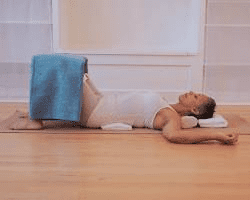
In this technique, the students lie down on their backs, but with their knees bent and feet on the ground.
This technique is preferred by many students because:
- They feel less exposed and vulnerable.
- The lower back region feels secure and comfortable.
- It is easy to change positions if necessary.
- The students are allowed to cover their pelvis and chest area with a blanket.
2. Side-Lying Rest
For some students, it feels better to rest lying on their side while holding a cushion or blanket between their legs. The side-lying rest is highly recommended as a trauma-informed technique as the body prefers this posture when feeling vulnerable.
Teachers should suggest to students that:
- They put a blanket underneath the head for support.
- One eye can be left gently opened, if desired.
- They can turn towards the wall or door.
3. Seated Meditation or Rest
Not all students find lying down easy to do. A sitting rest on the floor against a wall or in a chair allows the students to regulate themselves while still gaining from pause and integration. Sitting rest is particularly helpful for:
- Students experiencing hypervigilance
- Survivors of trauma
- Those with limited mobility
- Newbies are uncomfortable with silence
- Sitting rest may involve:
- Breathing exercise guidance
- Grounding through gentle reminders
- Soft gaze on visual points
4. Movement-Based Rest
Rest need not necessarily be done by remaining still.
Some nervous systems need movement to feel safe. Possible activities include:
- Rocking slowly
- Stretching gently
- Placing hands on the heart when breathing
- Walking meditation
- Gently swaying
5. Eyes Open Relaxation
Most people experience vulnerability when instructed to close their eyes.
Teachers should not ask anyone to close their eyes, but rather say:
- “You may soften your gaze.”
- “You are welcome to direct your sight toward the ceiling or toward some fixed point in the room.”
- “You may keep your eyes open.”
- By avoiding instructions about eye closing, much anxiety is eliminated.
- Language Choices in Trauma-Sensitive Sleep
The Role of Language in Trauma-Informed Rest
In many cases, the language used in traditional yoga practices includes:
- “Complete surrender.”
- “Melt onto the floor.”
- “Let go.”
- “Be still.”
Such language, though appropriate, can be perceived as triggering or intimidating to survivors of trauma. Trauma-informed language emphasizes invitations over commands.
Such invitations include:
- “If you wish, you may…”
- “Sense the support that exists.”
- “Explore breathing softly.”
- “Choose any position that makes you feel centered.”
Creating Emotional Safety in Yoga Spaces
Trauma-informed yoga is not just about changing postures. It is also about establishing an emotional safe space through the practice. Teaching methods to promote emotional safety during the final rest include:
- Explain options before doing Savasana
- Not making any surprise touches or adjustments
- Keep exits visible
- Maintaining a consistent schedule and routine
- Giving understandable verbal cues
- Provide an opportunity to leave or avoid the practice without judgment.
Small shifts like those mentioned above have a significant influence on students’ emotional safety within classes.
Why This Matters for Yoga Teachers
Modern yoga practitioners want more than flexibility or mobility. They seek spaces that provide them a sense of safety, dignity, and visibility.
The mental health literature suggests that trauma cases are very frequent. For example, many students joining yoga practices might suffer from:
- Anxiety disorders
- Grief
- Stress
- PTSD
- Physical or medical trauma
- Emotional abuse
- Burnout
It does not mean that teachers should become mental health professionals. However, knowledge of how trauma affects the body can enhance yoga practice.
A trauma-informed approach helps teachers:
- Establish trust with the students
- Increase class retention rates
- Prevent harm and injuries
- Make yoga more accessible
- Develop more diverse yoga communities
And most importantly, helps the students reconnect with their bodies.
Marketing Your Trauma-Informed Yoga Training
If you provide education and teacher trainings related to trauma-informed yoga, then this topic will be a great one for both educational purposes and marketing.
Yoga instructors are increasingly looking for information on:
- Teaching inclusively
- Nervous system regulation techniques
- Cueing with consent
- Creating an accessible class structure
- Trauma-informed sequencing practices
Information about the alternatives to Savasana is very interesting because it refutes an old stereotype and provides some great solutions.
The topic may be used for:
- Blog articles
- Carousels on Instagram
- Workshops and courses
- Teacher trainings
- Email campaigns
- Webinars
- Continuing education
Possible article hooks include:
- “Why Some People Hate the Pose of Corpse”
- “5 Ways To Make Relaxation Less Traumatic”
- “The Alternative Solutions To Traditional Final Rest”
- “Savasana: The Hidden Danger Behind It”
- “What Is Trauma Informed Yoga”
Educational materials create credibility and make your training attractive.
Conclusion on Why Savasana Can Feel Unsafe
Savasana can be extremely healing – but only when students feel comfortable enough to take rest.
Some people find comfort in being still, while others might experience unease, fear, or feelings of vulnerability when being still. Trauma-sensitive yoga calls upon us to let go of the notion that there’s only one proper way to rest.
Creating space for choice, respect for consent, and employing sensitive terminology can help yoga teachers establish environments where all students feel comfortable choosing how their version of Savasana will look.
The aim is not to achieve complete stillness.
The aim is to promote safety, autonomy, and presence.
If a sense of choice is achieved, relaxation can finally occur.
And healing starts then.
FAQs on Why Savasana can feel unsafe
1. What is trauma-informed yoga?
Trauma-informed yoga emphasizes emotional safety, consent, choice, and body awareness. Some yoga practices might be triggers for trauma survivors; therefore, alternative practices are suggested.
2. Why can the Savasana pose be a challenge for certain yoga students?
Savasana might be perceived as unsafe due to its static nature, vulnerability, the inability to observe one’s surroundings, and the sense of loss of control.
3. Should Savasana be completely excluded from yoga classes?
The removal of this practice isn’t necessary. Instructors should offer several variations to give students freedom of choice concerning resting positions.
4. Provide a few alternatives to Savasana in yoga practice.
Alternative options include lateral rest, sitting meditation, constructive rest pose, walking meditation, and movement meditation.
5. Are certifications in trauma necessary for yoga instructors?
It would help if you had additional knowledge of teaching practices to ensure safety, but starting with learning the language of trauma sensitivity would be a good option.