
Yoga has become one of the fastest-growing wellness movements of the last decade, and for good reason. Among its many branches, dynamic standing yoga poses stand out as one of the most practical and accessible ways to stretch, strengthen, and reset your body — whether you’re on your mat or squeezing in a quick break during your day.
Unlike seated or restorative postures, dynamic standing poses are usually held for shorter periods and involve continuous engagement of the legs, core, and arms. This makes them especially effective for building balance, stability, and mental focus — three of the most talked-about benefits of a consistent yoga asana practice.
At Oceanic Yoga School in Goa, students of all ages and experience levels come to learn these standing asanas and understand how to apply them in daily life. For those who want to go beyond personal practice and turn yoga into a career, Oceanic Yoga School also offers structured programs such as the 200 hour yoga teacher training in Goa, designed to build both technical skill and teaching confidence.
Below is a complete guide to 10 dynamic standing yoga poses, each listed with its Sanskrit and English name, along with clear instructions you can follow today.
10 Dynamic Standing Yoga Poses (With Sanskrit & English Names)
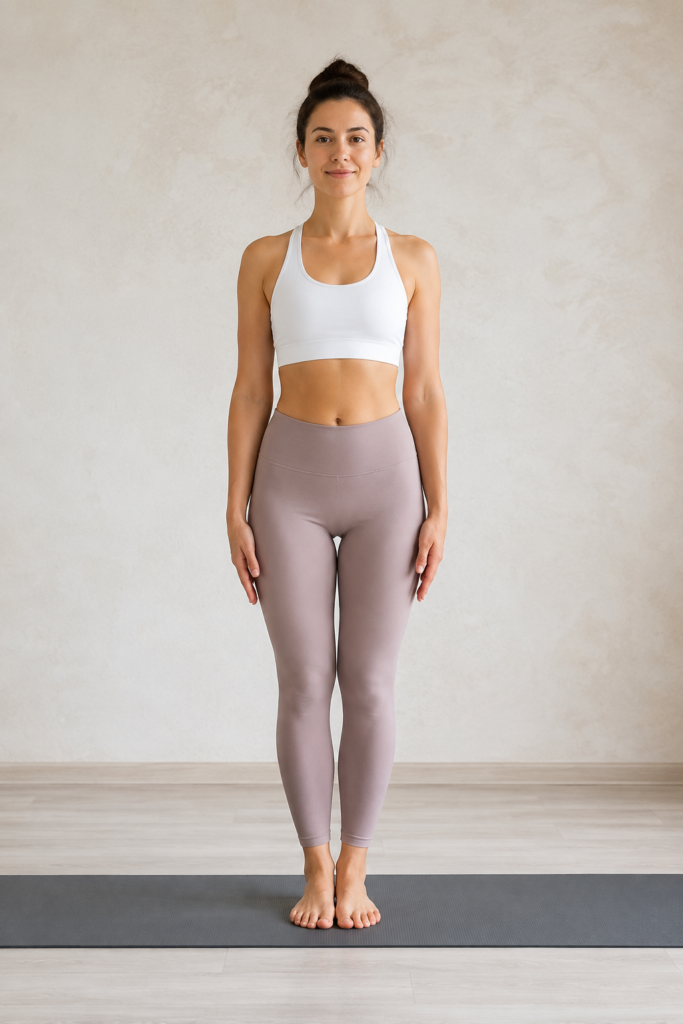
1. Mountain Pose (Tadasana)
Stand tall with your feet grounded and shoulders rolled back and down. Lengthen your spine so the crown of your head reaches upward while your feet stay firmly rooted. Inhale as you raise your arms overhead, then hold the position through several deep, steady breaths.
Also Read: Everything About Ancient Yoga Practice
2. Tree Pose (Vrksasana)
From standing, shift your weight onto your left foot. Bend your right knee and place your right foot against your left ankle, calf, or inner thigh — never directly on the knee joint. Bring your palms together at your chest or extend your arms overhead. Hold and breathe deeply before switching sides.
3. Forward Fold (Uttanasana)
Stand upright with your arms reaching toward the ceiling. Exhale and hinge forward from your hips, folding your torso over your legs. Bend your knees slightly if needed. Inhale into a half-lift, lengthening your spine, then exhale as you fold deeper. Hold and breathe.
4. Warrior One (Virabhadrasana I)
From a downward-facing dog, step your right foot forward between your hands. Lift your chest, pivot your back heel down, and press firmly through your front foot. Raise both arms overhead as you bend your front knee into a lunge. Hold with steady breath, then switch sides.
5. Warrior Two (Virabhadrasana II)
From a high lunge, open your hips and torso to the side, turning your back foot in slightly. Keep your front knee stacked directly over your ankle. Extend your arms in opposite directions, gazing gently over your front fingertips. Engage fully and hold before switching sides.
6. Dancer Pose (Natarajasana)
Begin standing with your weight on your left foot. Bend your right knee, reaching back to hold your right foot near the big toe side. Extend your left arm upward, then hinge slightly forward while pressing your foot into your hand for lift. Hold, breathe, then release with control.
7. Triangle Pose (Utthita Trikonasana)
Straighten your front leg and extend your arms into a “T” shape. Hinge at the hip and lower your right hand to your shin, ankle, or the floor outside your right foot. Extend your left arm straight up toward the ceiling. Hold and breathe evenly on both sides.
8. Triangle Twist (Parivrtta Trikonasana)
From Triangle Pose, bring your left hand down toward the mat. Rotate your torso to the right, opening your chest and right side. Reach your right arm up and gaze toward your fingertips. Hold with steady breath before switching sides.
9. Crescent Lunge (Ashta Chandrasana)
Step one foot forward between your hands, extending the back leg long behind you and lifting onto the ball of your back foot. Press firmly through your front foot as you rise into a high lunge, lifting your arms overhead with your gaze forward. Hold for several breaths before releasing.
10. Chair Pose (Eka Pada Utkatasana)
Stand tall and root down through your left leg. Lift your right knee and place the sole of your right foot on your left thigh. Flex your standing foot, hinge at the hips, and lower into a chair-like position. Hold, breathe, then repeat on the opposite side.
Why Practice Dynamic Standing Yoga Poses?
These 10 dynamic standing yoga poses do more than build flexibility. Practiced consistently, they:
- Improve balance and core stability
- Strengthen the legs, glutes, and lower back
- Boost blood circulation and deliver nutrients to muscles
- Support nervous system regulation through breath-linked movement
- Build mental focus and confidence, especially in single-leg poses
Because they’re quick to move through and don’t require lying down, standing poses are ideal for short practice breaks — at home, at work, or between longer yoga sessions.
Learn These Poses (and More) at Oceanic Yoga School, Goa
Whether you’re a beginner looking to build a home practice or someone ready to teach, Oceanic Yoga School in Goa offers structured, internationally recognized training. Choose from the 100 hour yoga teacher training for a foundational deep-dive, or the 200 hour yoga teacher training in Goa for a comprehensive, certification-ready path. Our school is certified by the World Yoga Alliance and welcomes students of all levels, both nationally and internationally.
FAQs About Dynamic Standing Yoga Poses
1. What are dynamic standing yoga poses?
Dynamic standing yoga poses are asanas practiced while standing, typically held for shorter durations and used to build balance, strength, and stability throughout the body.
2. Are dynamic standing poses suitable for beginners?
Yes. Poses like Mountain Pose and Tree Pose are beginner-friendly, while poses like Warrior I and Dancer Pose can be modified using props or wall support as strength and balance improve.
3. How long should I hold each standing pose?
Most standing poses are held for 5–8 deep breaths, though this can vary depending on your experience level and the flow you’re practicing.
4. What are the main benefits of standing yoga poses?
They improve balance, strengthen the lower body and core, support circulation, and help calm the nervous system through steady, breath-linked movement.
5. Can standing yoga poses help with posture?
Yes. Poses such as Tadasana (Mountain Pose) and Warrior II actively train spinal alignment, shoulder positioning, and overall postural awareness.
6. How can I go deeper into learning these poses?
You can join a structured program such as the 100 hour or 200 hour yoga teacher training in Goa at Oceanic Yoga School to build both practice depth and teaching skills.
Conclusion
Dynamic standing yoga poses are one of the most efficient ways to build strength, balance, and stability — all while staying accessible enough for daily practice. From the grounded simplicity of Tadasana to the focused challenge of Dancer Pose, each asana offers its own physical and mental benefits when practiced with attention and steady breath.
If you’re ready to deepen your practice or turn yoga into a profession, Oceanic Yoga School in Goa offers globally recognized 100 hour and 200 hour yoga teacher training programs to guide you every step of the way. Keep showing up on your mat, stay consistent with these standing poses, and let your practice grow one breath at a time.